
A 6-Step Stablecoin Depeg Readiness Checklist
• 8 min read • by Kelvin Jones
A 6-Step Stablecoin Depeg Readiness Checklist
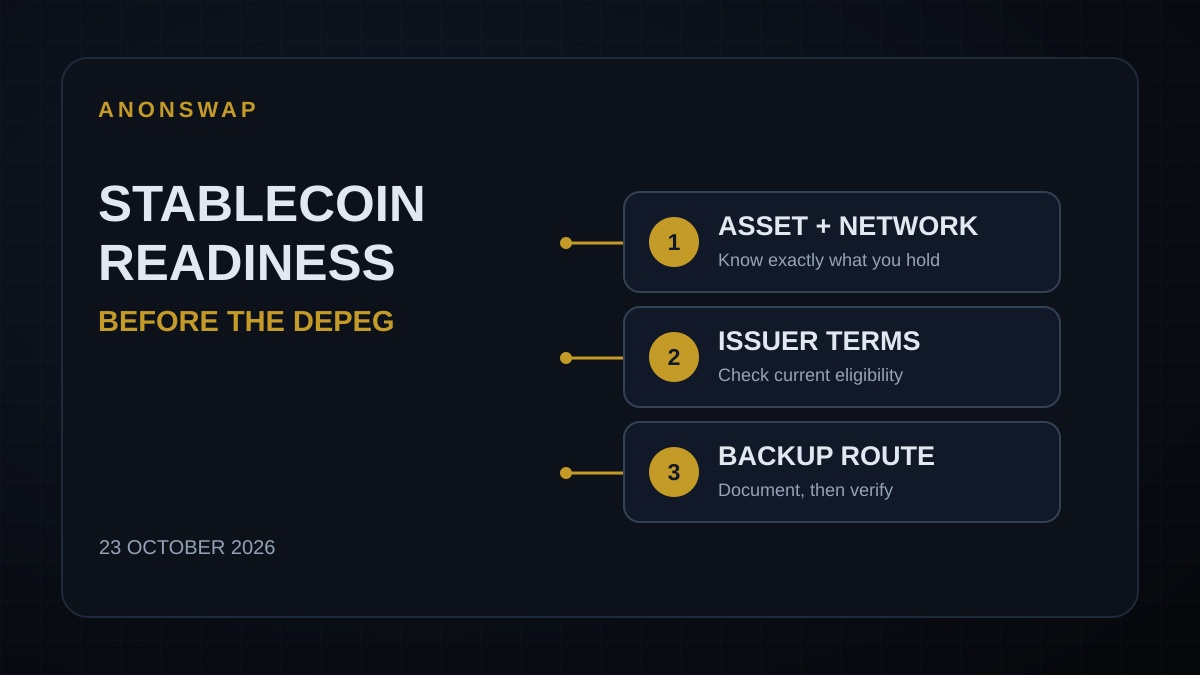
A stablecoin can trade away from its target value, and a fast response can introduce new risks: a wrong network, an unsuitable redemption route, or an avoidable identity trail. The useful time to check those details is before a market is moving quickly.
This guide builds a personal readiness sheet, not a trading signal or a recommendation to sell. The workflow helps you identify what you actually hold, check what the issuer says, and understand which lawful routes may be available to you. It also makes one point clear: crypto privacy is about understanding data exposure, not promising that a transaction is anonymous.
What You Need
- A private record of the stablecoin name, network, and approximate amount you hold.
- Access to the issuer’s official website and the relevant service terms.
- A secure place to store your own notes. Never include a seed phrase, private key, wallet password, or account recovery code.
Why Prepare Before a Depeg?
During a sharp price move, people may rush to a search result, social-media post, or unsolicited support message. That is when look-alike tokens, phishing pages, and hurried transfers become especially dangerous. On-chain transfers can be irreversible, and an issuer’s redemption terms may not cover every holder or location.
There is a privacy dimension as well. The Wednesday article, “Stablecoin Depegs: The Privacy Risk Hidden in the Exit”, explains how an account record and public blockchain activity can become linkable. The Monday post, “91 Days to the GENIUS Act: Why Stablecoin Depeg Risk Is Now a Privacy Risk”, covers the policy backdrop. This Friday guide is different: it turns that context into a personal preparedness workflow.
Privacy tools work at different layers. The Tor Browser is designed to defend against tracking and surveillance, and onion services are accessed through Tor. Neither changes the public record of an on-chain transfer or replaces checking an issuer’s URL and terms. Treat them as distinct parts of crypto privacy, not as a depeg exit route.
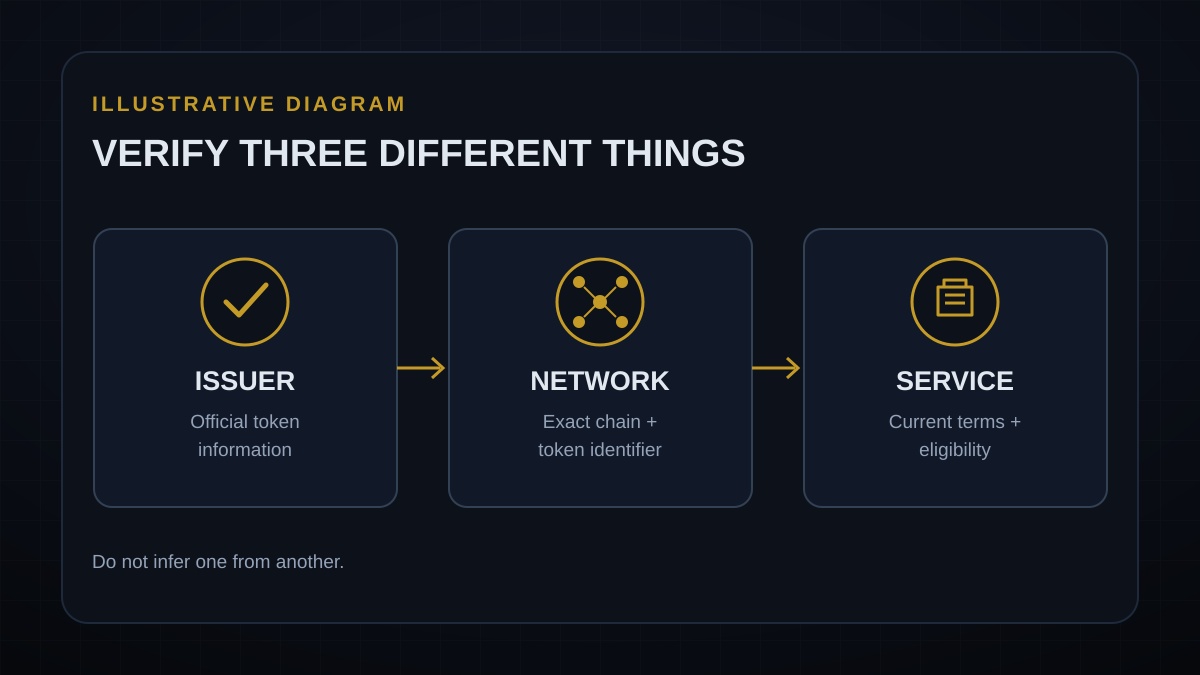
Do not treat a market price, a reserve report, and an issuer’s redemption terms as interchangeable evidence. A price is an observation from a venue at a particular time; reserve information describes assets reported by an issuer; terms describe conditions that apply to a service or holder. None alone tells you whether a specific route is available to you right now. Checking each source separately can prevent a rushed assumption from turning into a mistaken transfer or an unnecessary account submission.
The Six-Step Readiness Workflow
-
List the exact asset and network. Write down the token’s full name and symbol, the blockchain where it is held, and whether it is in a wallet you control or with a custodian. A ticker alone is not enough: similar names can refer to different tokens, and one stablecoin may exist on several chains. Note the source you used to identify it.
-
Verify the token from the issuer’s official source. Navigate to the issuer’s website directly, rather than following a message or an advertisement. Compare the network and token information against its official documentation. For example, Tether’s supported-protocols page lists the networks and token identifiers it supports. Circle’s USDC terms point to its supported blockchains. Never decide that a token is genuine based only on its name, logo, or a search result.
-
Read the current terms for your location and role. Look for eligibility, account, identity-verification, minimum, fee, and jurisdiction requirements. Do not infer that holding a token automatically gives you a direct issuer-redemption path. Circle’s USDC terms state that holders without a Circle Mint account cannot redeem directly with Circle unless they open an eligible account; the terms also point EEA holders to a separate white paper. Tether directs users with redemption questions to its support and supported-protocol information. Record the date you checked and the exact official page.
-
Write down two lawful backup routes. One option might be a provider or exchange account you already use; another might be a non-custodial swap, if the exact asset and network are supported for your intended route. For each, record where to find current terms, what identity information might be required, and what fees or network costs to check. Treat a route as an option to investigate—not as a guaranteed exit, quote, or recommendation to trade.
-
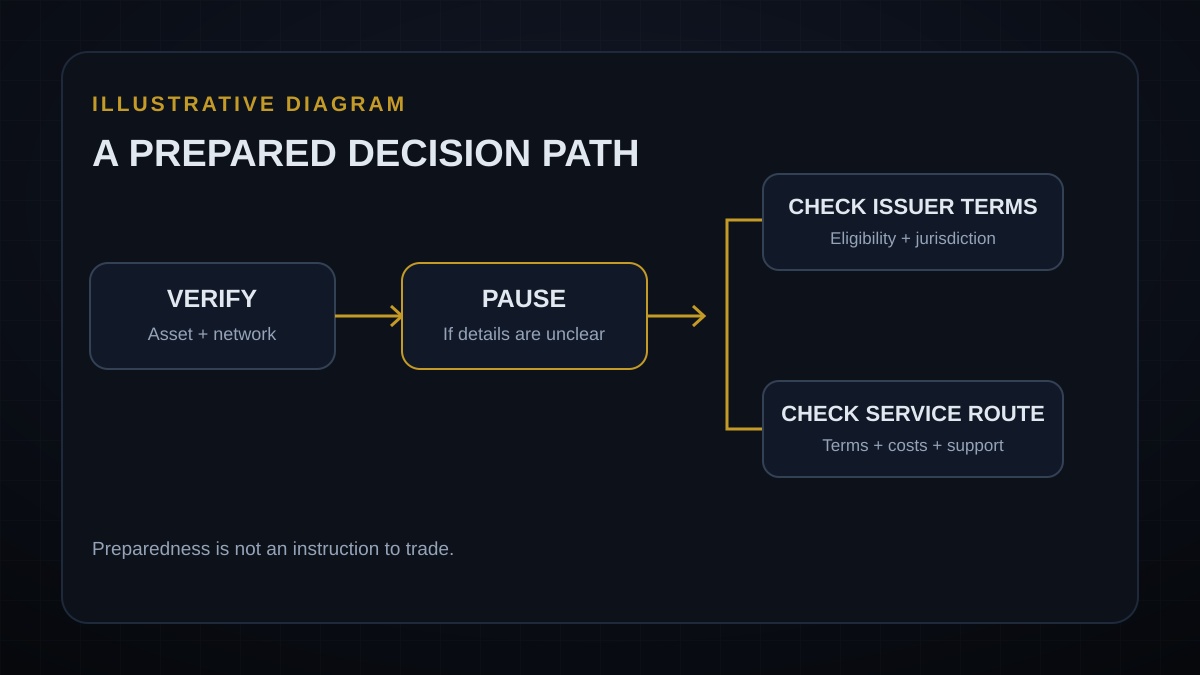
Check the destination and the operational details before acting. Confirm that the receiving service supports the same asset and network you intend to send. Match the network, asset, and destination address carefully, and review any displayed quote, minimum, fee, expiry, and transaction instructions before you authorize a transfer. If any detail is unclear, stop and use the provider’s verified support channel. Do not test a route with a transfer you cannot afford to lose.
-
Keep a small, safe readiness record and review it. Store official URLs, checked dates, the network, and the questions you still need answered in a protected note. Do not store wallet secrets in it. Recheck the issuer’s terms and route availability periodically, because documentation, supported networks, and service conditions can change. The note is a reference for careful decisions, not an instruction to act whenever a price moves.
Your record can be brief: one line per holding, then a source link and a “last checked” date. You might also write down the point at which you would pause and gather more information, rather than selecting a price at which to buy or sell. That pause rule is a safety process, not financial advice. If a provider cannot clearly explain the supported network, requirements, or fees, mark the route unverified and do not fill the gap with a guess.
Common Mistakes and Privacy Leaks
- Trusting a token label instead of its network and identifier. Token symbols can be copied. Check the issuer’s own supported network information before relying on a displayed name.
- Treating a peg or reserve statement as a personal redemption promise. A token’s terms, your location, and your eligibility matter; market price and issuer redemption are different questions.
- Following urgent messages. A support account that asks for a recovery phrase, private key, or password is not a safe route. Go to the official domain yourself and never share wallet secrets.
- Assuming a swap removes public records. A non-custodial transaction can still be visible on a public blockchain, and a service or routing partner may have its own requirements and records.
- Moving through extra services without a reason. Each added intermediary can mean another counterparty, another set of terms, and potentially another record to understand.
How AnonSwap Fits Into the Workflow
AnonSwap describes itself as a non-custodial swap service that does not require an account or wallet connection. The FAQ says users send funds to a one-time deposit address and receive a payout address. Those facts may help you compare account requirements as you document a potential route; they do not promise anonymity, price stability, a particular asset route, or access during market stress.
Before relying on any service, including AnonSwap, check the current route and its details. Routing partners, asset, amount or volume, network conditions, and local law can affect what a swap supports or requires. Your notes should capture the conditions, not assume an outcome. A public-chain transfer may remain observable, and each provider’s privacy terms should be reviewed directly.
If you choose to use non-custodial swaps, keep the activity lawful and confirm the relevant asset, network, quote, fees, and destination before sending. Do not use privacy tools to evade sanctions, laundering controls, taxes, or other legal obligations. Protect your own credentials and do not share them with anyone claiming to help you redeem or swap.
Your Privacy Checklist for This Week
- Record each stablecoin’s exact name, network, and custody arrangement.
- Verify token details and supported networks using the issuer’s official documentation.
- Read current redemption terms for your location and confirm eligibility instead of assuming it.
- Note two lawful backup routes, their data requirements, and the questions to recheck.
- Store the readiness note without keys, recovery phrases, or passwords, and review it before any urgent transfer.
Sources: Circle, USDC Terms (last updated October 15, 2026), USDC Risk Factors (last updated October 27, 2023), and USDC Transparency; Tether, Supported Protocols and Redeem; Tor Project, Tor Browser and Onion Services; MetaMask Help Center, Token Safety Practices; AnonSwap, FAQs. Checked October 23, 2026. These are online documents, not versioned software releases; no wallet or operating-system version is required by this documentation-only workflow. This article is informational and is not legal or financial advice. Follow the laws and tax rules where you live.
Published October 23, 2026. Last updated October 23, 2026.
Frequently asked questions
What should I do before a stablecoin depeg?
Record the exact token, network, custody arrangement, issuer terms, and lawful backup routes you could use. Verify current eligibility and requirements from official sources before any urgent decision.
Does a non-custodial swap make a depeg exit private or guaranteed?
No. A non-custodial service does not guarantee anonymity, a fixed price, liquidity, or a successful route. Partners, asset, amount, network conditions, and local law may affect what a swap requires.
Can every stablecoin holder redeem directly with its issuer?
Not necessarily. Issuer terms can set account, eligibility, jurisdiction, and other conditions. Check the current terms for the specific token and your location rather than assuming direct redemption is available.