
Stablecoin Depegs: The Privacy Risk Hidden in the Exit
• 8 min read • by Kelvin Jones
Stablecoin Depegs: The Privacy Risk Hidden in the Exit
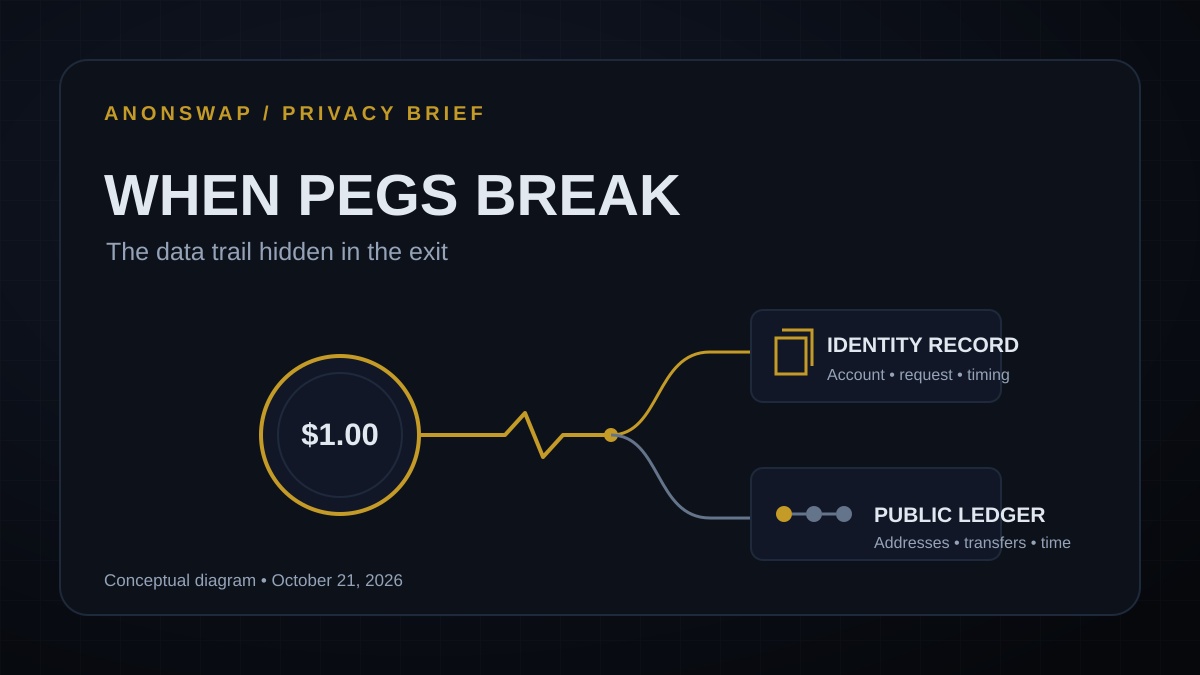
A stablecoin can lose its dollar peg in minutes, but the consequences of getting out may last much longer. When the market price slips, users look for the fastest credible route to redeem, exchange, or move funds. That urgency can push them toward a platform or issuer where identity checks, account histories, and transaction records meet a public blockchain.
The privacy risk is not that every exit is monitored in the same way, or that a depeg automatically reveals a wallet owner. It is that stress changes behavior. People repeat actions, consolidate funds, and use familiar services. Those decisions can create links between a real identity and a wallet whose transaction history was previously only pseudonymous.
A Depeg Is a Market Event; the Data Trail Is a Process
A stablecoin is designed to track a reference value, commonly one U.S. dollar. Its market price can move away from that value when buyers doubt redemption, liquidity becomes thin, a banking or reserve concern emerges, or trading venues become temporarily disconnected. These are different mechanisms; a visible price discount alone does not prove that reserves are missing or that redemption has stopped.
The March 2023 USDC episode showed how concern about banking exposure could affect market confidence. Circle disclosed that a portion of USDC reserves was held at Silicon Valley Bank, and USDC traded below one dollar before returning toward its target after the bank situation was addressed. The important lesson for privacy is not a prediction about future events. It is that a user response to uncertainty can create a second, separate trail: the trail of where they sought liquidity.
That trail may involve several kinds of information:
- Account data: an exchange or redemption provider may associate a verified customer profile with activity on its service.
- Transaction data: a public blockchain may show addresses, timestamps, values, and contract interactions, depending on the network.
- Connection data: a service or network provider may process information such as request timing or an IP address, according to its systems and policies.
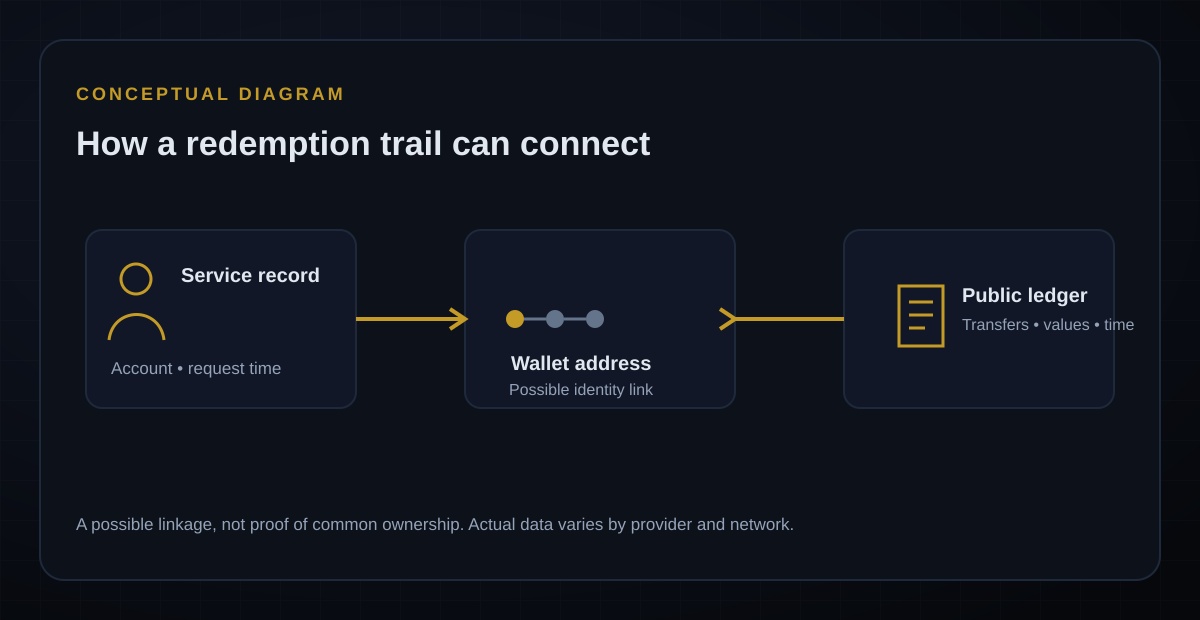
No single item necessarily identifies a person. The risk grows when separate records can be joined. That is the practical meaning of metadata leakage during a market event: information around a transfer can reveal context even when a transaction does not contain a name. This is one way financial surveillance can become more consequential without any single record containing a complete picture.
How the Link Is Made
Blockchain analytics does not need to break encryption to draw useful inferences. Analysts can inspect public transactions and look for recurring patterns, such as addresses that interact with the same service or assets that move in a visible sequence. A 2013 academic study demonstrated address-linking heuristics on Bitcoin; those observations are clues, not proof that one person controls every address in a cluster, and findings about Bitcoin should not be generalized automatically to every network. Shared services, exchanges, and automated contracts can make the same pattern appear for many unrelated users.
The political and commercial setting matters too. Financial institutions and service providers may have record-keeping obligations, while analytics vendors sell tools that help clients interpret on-chain activity. A public address becomes more sensitive when an off-chain record associates it with an account, a withdrawal, or a redemption request. The chain itself has not changed; the identity link has.
During a depeg, users may make several connected moves close together: check prices, transfer to a venue, attempt a redemption, or swap into another asset. That sequence can be easier to correlate than a single routine payment. This is a risk model, not a claim that every provider collects the same data or that every transfer is deanonymized.
Financial Rules and Privacy Are Different Questions
The U.S. Treasury’s August 18, 2026 proposed rule on the GENIUS Act concerns statutory restrictions and limits on payment stablecoin issuance, offer, and sale. It is a rulemaking document about who may issue or offer certain stablecoins in the United States. It should not be confused with evidence that a particular wallet has been identified or that every transaction is individually monitored.
That distinction helps users reason clearly: a measure aimed at issuer eligibility can affect which products or routes remain available, while a personal data trail depends on the services and transactions a user actually touches. Monday’s macro view of the GENIUS Act comment deadline covers the policy calendar. This article looks instead at the technical path from a stressed stablecoin position to identity-linked records.
Global Context: The Same Chain, Different Rules
Privacy and redemption conditions do not stop at borders. The same token can be used through providers subject to different legal regimes, and the rules for issuers are not automatically the same as the rules for an exchange or an individual user.
| Region | What users should distinguish |
|---|---|
| United States | Treasury’s 2026 proposal addresses statutory limits on issuance, offer, and sale; it is not a record of an individual wallet. |
| European Union | MiCA distinguishes asset-referenced tokens from e-money tokens; users should check which category and service provider apply. |
| Canada | Check the current requirements for the particular issuer and service provider instead of assuming a U.S. or EU pathway applies. |
| Africa | Rules and access conditions are country-specific; no single national example should be treated as a continent-wide rule. |
| Asia | Regulatory approaches vary by jurisdiction. Hong Kong’s stablecoin issuer work is one local example, not a summary of the region. |
The table is a jurisdiction-checking guide, not legal advice. The European Union’s Markets in Crypto-Assets Regulation (MiCA) text and the Hong Kong Monetary Authority’s stablecoin consultation materials illustrate why the location and role of the service matter. For users in Canada and across African and Asian jurisdictions, verify local requirements before relying on a redemption route.
Privacy Erosion in Digital Finance
Compliance rules can serve legitimate goals, including consumer protection and financial integrity. The privacy question is narrower: what data is collected, for what purpose, how long it is retained, and which other records can be linked to it?
For a user who only wants to leave a depegged asset, the exposure often comes from stacking services. A customer account may identify the person. The provider’s transaction records may show the time and value. A public ledger can then reveal the destination address and later movements. None of those layers alone tells the whole story, but together they can shrink the distance between a wallet and a name.
Good privacy practice cannot make this information disappear after the fact. It can reduce avoidable links beforehand. Privacy tools are most useful when they help users understand and limit unnecessary data collection, not as a reason to evade lawful controls.
How Non-Custodial Swaps Protect Users
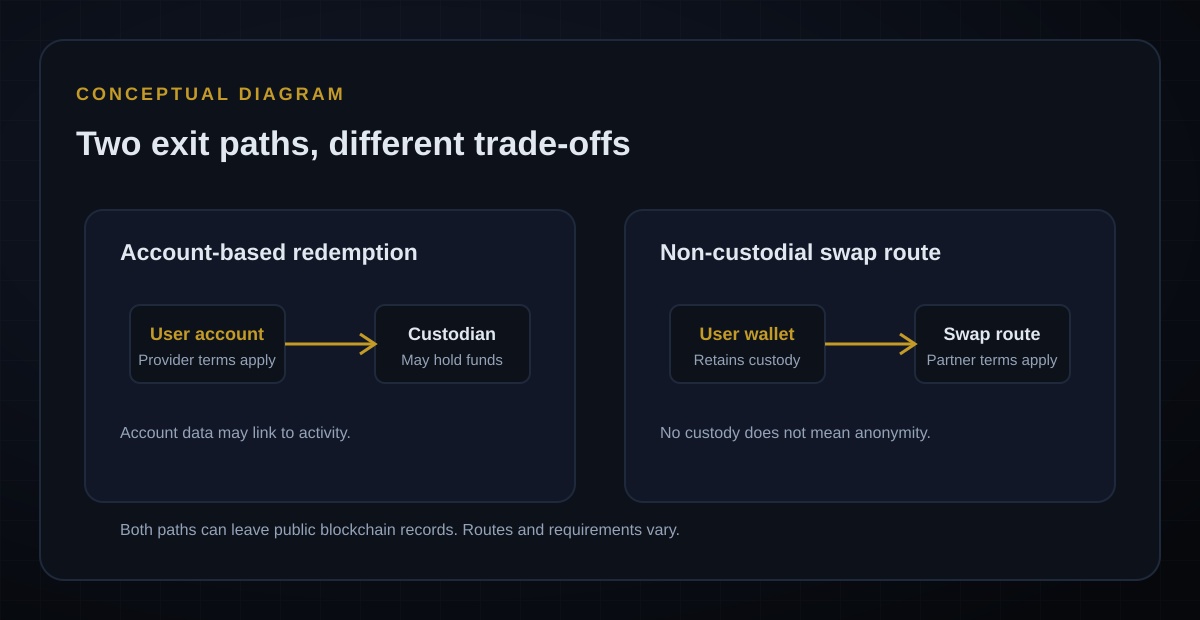
A non-custodial swap is structured so the service does not take custody of the user’s assets as an account balance. This can reduce one class of exposure: there is no platform-held balance that depends on the service to release the user’s funds. It does not erase the public transaction record, ensure a fixed price, or remove all service-provider data.
The relevant comparison is not “surveilled” versus “invisible.” It is which party holds funds and which data is required for a particular route. Routing partners, the asset, amount, local law, network fees, and liquidity can affect the process. A user should review the actual terms and requirements, especially when the market is moving quickly.
Before choosing a route, check three separate questions:
- Custody: which party, if any, can hold or release the funds?
- Identity: what information does each service require for this asset and amount?
- Ledger: which details will remain visible on the relevant public blockchain?
AnonSwap’s Privacy Architecture
AnonSwap offers non-custodial swaps without requiring users to create an account. Those are concrete design properties that can limit the amount of account-profile information a user supplies directly to the service. They do not amount to an anonymity guarantee.
The broader transaction still interacts with blockchain networks and may involve routing partners. What a particular swap requires can vary with the route, asset, amount, partner, and local law. Users should not assume that a non-custodial service can make a public-chain transaction private, prevent analytics, or bypass an issuer’s or partner’s lawful requirements. A careful approach is to understand each party’s role before moving funds.
How Users Can Protect Themselves This Week
If a stablecoin begins to trade away from its peg, slow the decision down enough to check the path, not just the price. These lawful steps reduce avoidable exposure without promising invisibility:
- Check issuer communications and redemption terms from an official source; do not treat a market discount alone as proof of insolvency.
- Identify which services in a proposed route require an account, identity verification, or additional information, and review their current privacy terms.
- Avoid moving funds through multiple services without a clear reason. Each additional intermediary may create another record or counterparty risk.
- Keep wallet security separate from privacy: protect recovery phrases, verify destination addresses, and never share signing credentials to “unlock” a redemption.
- If using a non-custodial swap, confirm the asset, route, fees, and partner requirements first. Remember that the resulting blockchain activity may remain public.
- Follow local law and seek qualified advice for a material redemption or regulatory question; privacy tools do not exempt users from legal obligations.
The central lesson is modest but useful. A stablecoin depeg can change the route a person takes, and the route can change what data is linked. Understanding custody, account requirements, and public-ledger visibility before a crisis gives users more control over that decision.
Sources: U.S. Department of the Treasury, GENIUS Act proposed rule published in the Federal Register, August 18, 2026; Reuters, reporting on the USDC depeg and Silicon Valley Bank exposure, March 11, 2023; Circle, USDC and Silicon Valley Bank disclosures, March 2023; Meiklejohn et al., “A Fistful of Bitcoins: Characterizing Payments Among Men with No Names,” ACM Internet Measurement Conference, October 2013; European Union, Markets in Crypto-Assets Regulation (EU) 2023/1114, May 31, 2023; Hong Kong Monetary Authority, stablecoin issuer consultation materials, December 27, 2023. Regional descriptions are general and users should verify current local law. This article is for informational purposes and is not legal or financial advice.
Published October 21, 2026. Last updated October 21, 2026.
Frequently asked questions
Why can a stablecoin depeg expose personal information?
A depeg can send users toward issuers, exchanges, and other service providers that may collect identity and transaction details. Public blockchains also preserve address-level activity, so an identity link can make past transfers easier to associate with a person.
Does a non-custodial swap make a stablecoin transaction anonymous?
No. Non-custodial describes who holds the assets, not whether a transaction is anonymous. Routing partners, the asset, transaction size, local law, and public-chain data can all affect exposure.
How does AnonSwap approach privacy?
AnonSwap offers non-custodial swaps without requiring an account. That can reduce the identity data a user must provide to the service, but it is not an anonymity guarantee and requirements can vary.