
91 Days to the GENIUS Act: Why Stablecoin Depeg Risk Is Now a Privacy Risk
• 8 min read • by Kelvin Jones
91 Days to the GENIUS Act: Why Stablecoin Depeg Risk Is Now a Privacy Risk
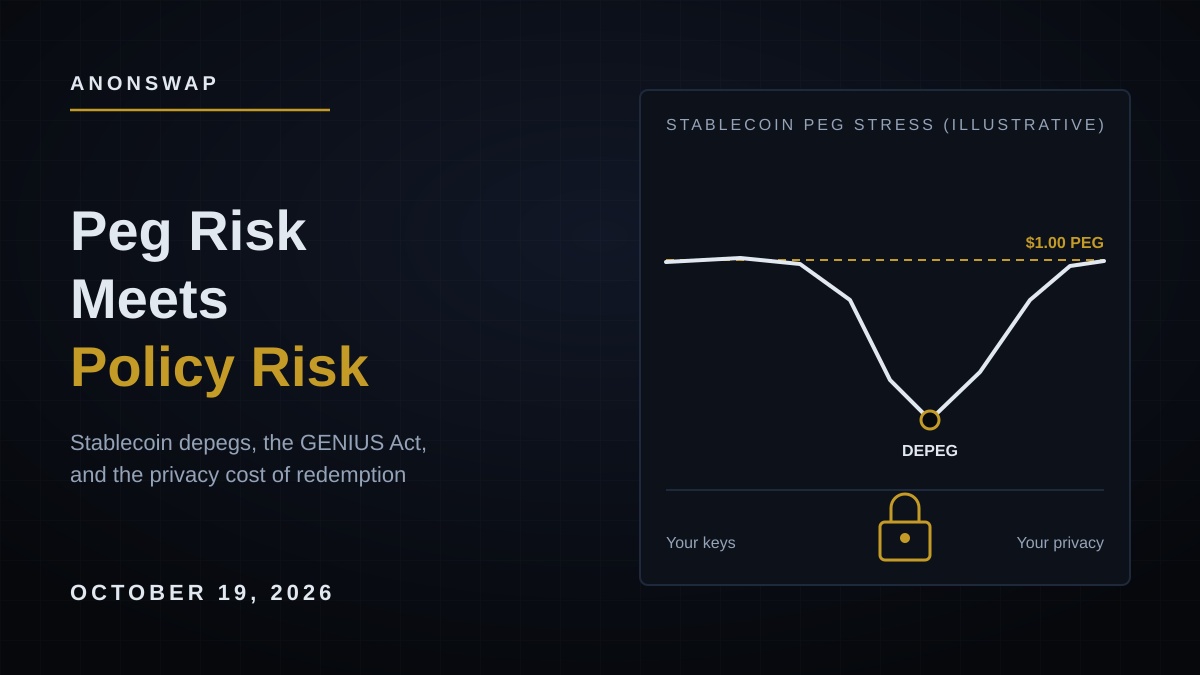
A stablecoin is a promise: one token, one dollar, redeemable on demand. For most days that promise holds, and nobody thinks about it. The days it does not hold are the days users learn who controls access to their money, what identity records sit behind it, and how quickly those records matter.
Today, October 19, 2026, the public comment period closes on the U.S. Treasury's proposed rule implementing Section 3 of the GENIUS Act, the federal framework for payment stablecoins. This week's story is a policy deadline, not a price event. But the two are linked. The rules written from this point will shape how stablecoins are issued, who may offer them, and what happens to users when a peg comes under stress.
What Happened: The GENIUS Act Comment Window Closes
Treasury issued a Notice of Proposed Rulemaking in August to define what it means to "issue a payment stablecoin in the United States" and what it means to "offer or sell" one to a person "in the United States." According to Treasury's announcement, the public had 60 days from Federal Register publication to respond. That window ends today.
The timeline Treasury lays out is concrete:
- January 18, 2027: the expected effective date of the Act. From then, a person generally may not issue a payment stablecoin in the United States without an appropriate federal or state license.
- January 18, 2027 (offering): digital asset service providers generally may not offer foreign-issued payment stablecoins unless the foreign issuer can comply with lawful orders and any reciprocal arrangement between the United States and its home jurisdiction.
- July 18, 2028: digital asset service providers generally may not offer or sell payment stablecoins to persons in the United States unless the coins come from a licensed issuer.
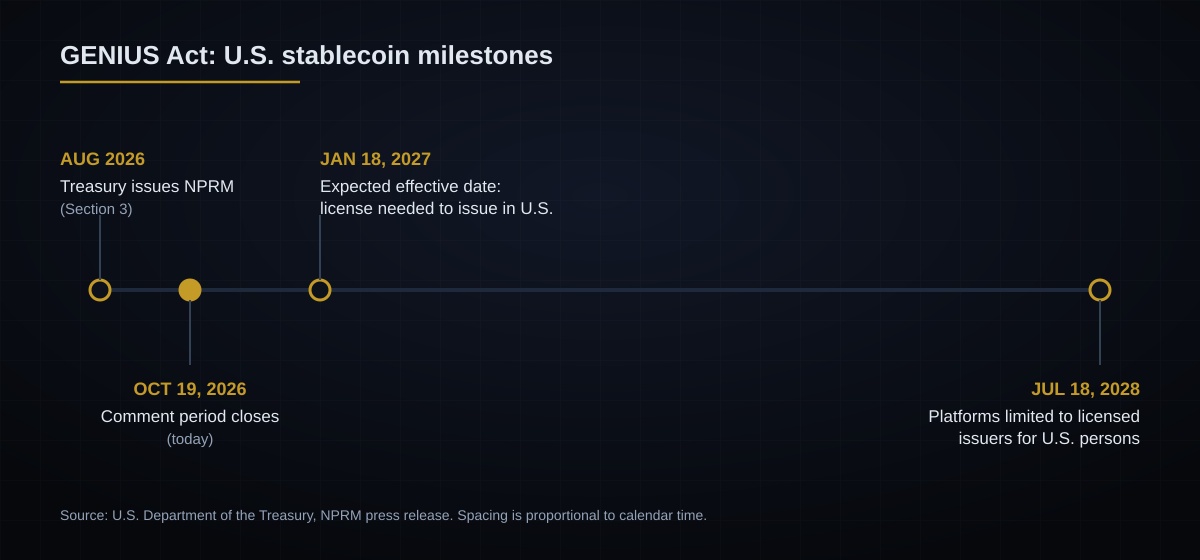
Counting from today, the effective date is 91 days away.
Industry engagement has been heavy. Reporting on the docket describes more than 105 comments filed, including submissions from trade groups for banks and from crypto-native firms. The reported fault lines are the scope of the prohibition on stablecoin yield and how foreign issuers will be treated. As of that reporting, Treasury had not determined any foreign regime, such as the EU's MiCA, to be comparable under the Act. We report those points as they appear in the public record, and final rules may differ.
Why Depeg Risk Belongs in a Privacy Discussion
Reserve quality, redemption rights, and licensing are designed to make depegs rarer. That is a legitimate goal. Stablecoin failures are costly, and users deserve clear rules on backing and redemption.
Still, no framework removes peg risk entirely. USDC traded at roughly 87 to 88 cents in March 2023 after Circle disclosed reserves held at Silicon Valley Bank, before recovering. A fiat-backed coin can wobble because of a bank, a custodian, or a liquidity squeeze, even when the issuer is solvent.
The privacy issue is what the user must do next. Redemption with an issuer, or an exit through a regulated platform, typically runs through identity verification and record keeping. In a calm market, that is a minor inconvenience. In a stressed market, it concentrates urgency, exposure, and dependence at once: users act quickly with little time to compare options, identity-linked records are created exactly when balances and transfers are most sensitive, and access depends on a platform's willingness and ability to process requests.
This is the quiet link between stablecoin policy and financial surveillance. Compliance requirements are usually discussed as a cost to businesses. For users, they are also a data trail.
Global Context: A Convergent Stablecoin Rulebook
The U.S. is not acting alone, and the direction is consistent.
- United States: the GENIUS Act framework centers on licensing, with Treasury's proposal addressing issuance and offering. Rules are still being finalized.
- European Union: MiCA's stablecoin provisions have applied since mid-2024, setting requirements for issuers of e-money tokens and asset-referenced tokens, with the wider crypto-asset service provider rules following in December 2024.
- Canada: Parliament has enacted a federal stablecoin framework that places fiat-backed stablecoin issuers under Bank of Canada supervision. Supporting regulations were still in development at the time of writing.
- Africa: Kenya signed a Virtual Asset Service Providers Act in 2025, creating a licensing regime for exchanges and wallet providers. Implementation depends on follow-up regulations.
- Asia: Hong Kong's Stablecoins Ordinance took effect on August 1, 2025, requiring a Hong Kong Monetary Authority licence for relevant issuers.
| Jurisdiction | Instrument | Core Approach |
|---|---|---|
| United States | GENIUS Act (rules pending) | Federal and state licensing of issuers |
| European Union | MiCA | Authorization and reserve rules for token issuers |
| Canada | Federal stablecoin framework | Bank of Canada supervision of issuers |
| Kenya | VASP Act, 2025 | Licensing of service providers |
| Hong Kong | Stablecoins Ordinance | HKMA licensing of issuers |
Summary of publicly announced regimes. Details, dates, and implementation status vary by jurisdiction.
For global crypto markets, the practical result is more regulated on-ramps and off-ramps, and more data collected at each of them.
Market Psychology: Fear, Uncertainty, and Herd Behavior
Stablecoins sit at the center of trading, collateral, and settlement. That is why even small peg deviations carry outsized psychological weight. Four patterns recur:
- Fear: a peg that slips by a fraction becomes a signal that something is broken, even if the cause is thin liquidity.
- Uncertainty: unclear redemption terms or delayed disclosures invite worst-case assumptions.
- Herd behavior: when others exit, staying feels riskier than leaving, and exits compound the pressure.
- Overconfidence: long periods of tight pegs teach users to treat stablecoins as cash, so few have a plan for the day they are not.
Regulation can reduce uncertainty by making reserve and redemption rules explicit. It cannot remove the behavior. A user who has already prepared a way to hold and move assets without depending on a single platform is less likely to act out of panic.
Privacy Implications for Everyday Users
Stablecoin regulation affects ordinary users in specific ways:
- Platforms that must prove which coins they may offer will collect and retain more information about customers.
- Foreign-issued stablecoins may become harder to access through regulated venues in some jurisdictions, depending on how comparability is decided.
- Records created during a stressed redemption can persist long after the market has normalized.
- Public blockchains already make transaction histories visible. Linking an address to a verified identity makes that history personal.
None of this is an argument against rules on reserves or redemption. It is an argument for being deliberate about where identity is attached to activity, and for keeping options that do not require attaching it.
How Non-Custodial Swaps Protect Users
A non-custodial swap lets you exchange assets from your own wallet to your own wallet, without handing funds to a platform to hold. That structure changes the risk profile in two ways.
First, there is no account balance that a platform can freeze or limit. Your keys remain yours throughout the transaction. Second, there is no registered customer profile that accumulates a history of your activity.
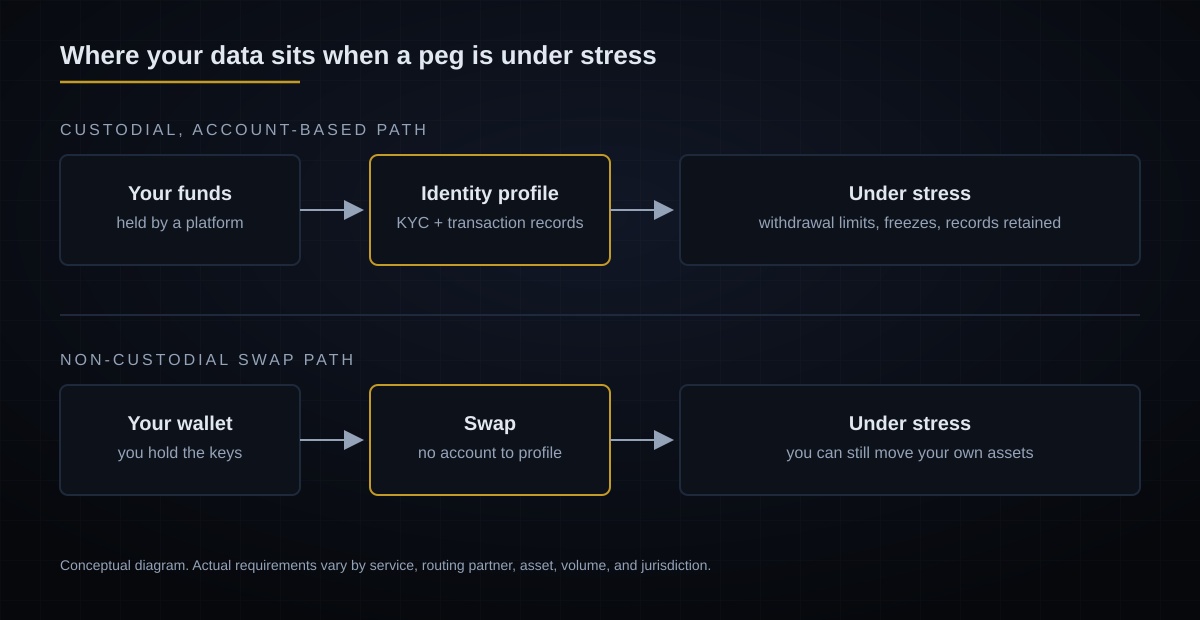
Non-custodial swaps do not eliminate market risk. If a stablecoin loses its peg, you still hold a stablecoin that has lost its peg. What they preserve is agency: the ability to rebalance into other assets on your own terms, and a smaller data footprint while you do it. For more background, see why non-custodial swaps matter and our earlier analysis of the stablecoin crackdown and privacy-first swaps.
AnonSwap's Role in the Privacy Ecosystem
AnonSwap provides non-custodial swaps without requiring users to create an account. It is one of the privacy tools users can combine with good wallet practices, such as separating wallets by purpose and avoiding address reuse.
We are direct about the limits. Routing partners, asset choice, transaction size, and local law can all affect what a given swap requires, and users remain responsible for complying with the rules where they live. AnonSwap's role is not to circumvent regulation. It is to give users a way to transact while keeping custody and limiting unnecessary data collection, which is a position consistent with a market that is becoming more regulated, not less.
The Privacy Outlook for the Week Ahead
The comment period closing does not end the process. Treasury and other agencies must now review the record and publish final rules ahead of the expected January 18, 2027 effective date. Several items deserve attention in the coming days:
- Treatment of foreign issuers: whether and how Treasury addresses comparability for regimes such as MiCA.
- Scope of the yield question: how definitions affect rewards offered through exchanges and third parties.
- Platform responses: whether exchanges and service providers announce changes to stablecoin availability or verification ahead of the effective date.
- Peg monitoring: whether any major stablecoin shows a sustained deviation, and how redemption channels respond.
A practical checklist for users: know which stablecoins you hold and how each is backed and redeemed; avoid concentrating holdings with one issuer or platform; decide in advance how you would rebalance if a peg broke; keep custody of your own keys wherever possible; and understand what identity information each service you use retains.
Policy is being written now, and the decisions will outlast this week's headlines. The users best placed to handle them are the ones who treat privacy and custody as part of risk management, not as an afterthought.
Sources: U.S. Department of the Treasury, NPRM press release on GENIUS Act Section 3 (home.treasury.gov); reporting on the Treasury NPRM comment docket (Yahoo Finance); Hong Kong Government and Library of Congress notices on the Stablecoins Ordinance; public MiCA implementation timelines. This article is for informational purposes and is not legal or financial advice.
Published October 19, 2026. Last updated October 19, 2026.
Frequently asked questions
What happens on October 19, 2026 for the GENIUS Act?
The public comment period on the U.S. Treasury's proposed rule for issuing, offering, and selling payment stablecoins closes, ending the main public feedback phase before final rules are written.
When does the GENIUS Act take effect?
Treasury describes January 18, 2027 as the expected effective date, when issuing a payment stablecoin in the United States generally requires an appropriate federal or state license.
Why does a stablecoin depeg matter for privacy?
Depegs push users toward redemption and exchange channels that rely on identity verification and record keeping, which links personal identity to financial activity at the moment of greatest stress.
How do non-custodial swaps help during stablecoin stress?
You keep control of your keys and move assets without a platform account that can be frozen or profiled, although requirements still vary by service, routing partner, asset, volume, and jurisdiction.