
The Wallet Purchase Trail: How API Privacy Can Expose Crypto Ownership
• 8 min read • by Kelvin Jones
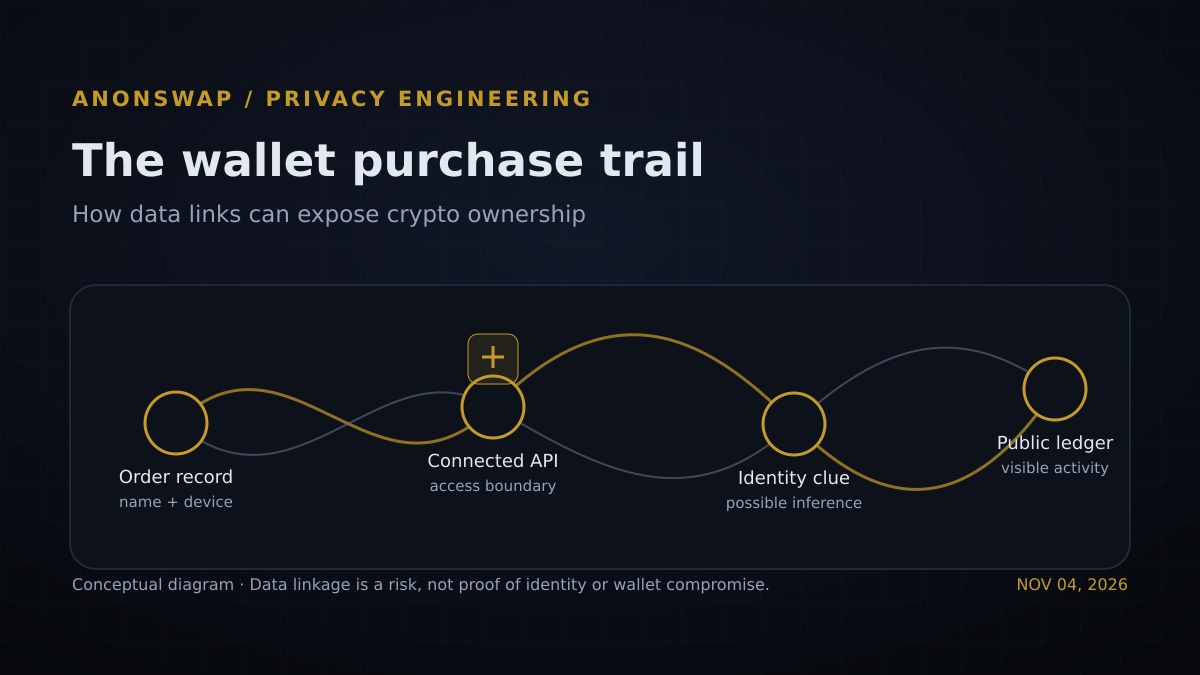
The Wallet Purchase Trail: How API Privacy Can Expose Crypto Ownership
A hardware wallet can keep signing keys offline and still leave a sensitive trail elsewhere. On October 26, 2026, Keystone said a third party that accessed its website obtained customer information and a key used to verify device authenticity. The company's statement said the attacker exploited a vulnerability in a third-party data-monitoring tool. Its update also disclosed that 25,964 Shopify buyer records from 2024 through 2026 still contained personal information, including names, contact details, shipping addresses, and order information.
That is not the same as a recovery phrase or private-key breach. Keystone said those wallet credentials were not involved. The privacy concern is different: a purchase record can connect a named person and delivery address to a crypto device. When such off-chain records are exposed, public blockchain data can become more personally revealing if another source links an identity to an address. This is the technical angle behind Monday's look at the Foundation API incident: here, the focus is the storefront and the data trail around ownership, not spoofed email.
What Keystone reported—and what it does not prove
Keystone's October 26 update said an attacker exploited a vulnerability in a third-party monitoring tool on its website, escalated privileges, and obtained customer information and a device-authentication key. The company said the affected data came from its Shopify store; purchases through Amazon and other channels were not included. It also acknowledged that an automated erasure process did not work reliably, so some personal information remained beyond its stated 180-day retention period (Keystone, October 26, 2026).
The Hacker News reported the disclosed figure of 25,964 buyer records with personal data and described the key's function: it lets a device prove its authenticity through an online check. Keystone said the key was not a wallet signing key, and the report said the company had not reported counterfeit devices or theft from the incident (The Hacker News, October 27, 2026).
The distinction matters. An exposed order record does not show that the device's recovery phrase was accessed, that the customer made a particular transaction, or that a public address can be attributed to that person. Nor does disclosure of a device-authentication key establish that a counterfeit was sold. It shows a risk surface and a set of confirmed records—not every downstream consequence.
The data path: from a storefront to an identity clue
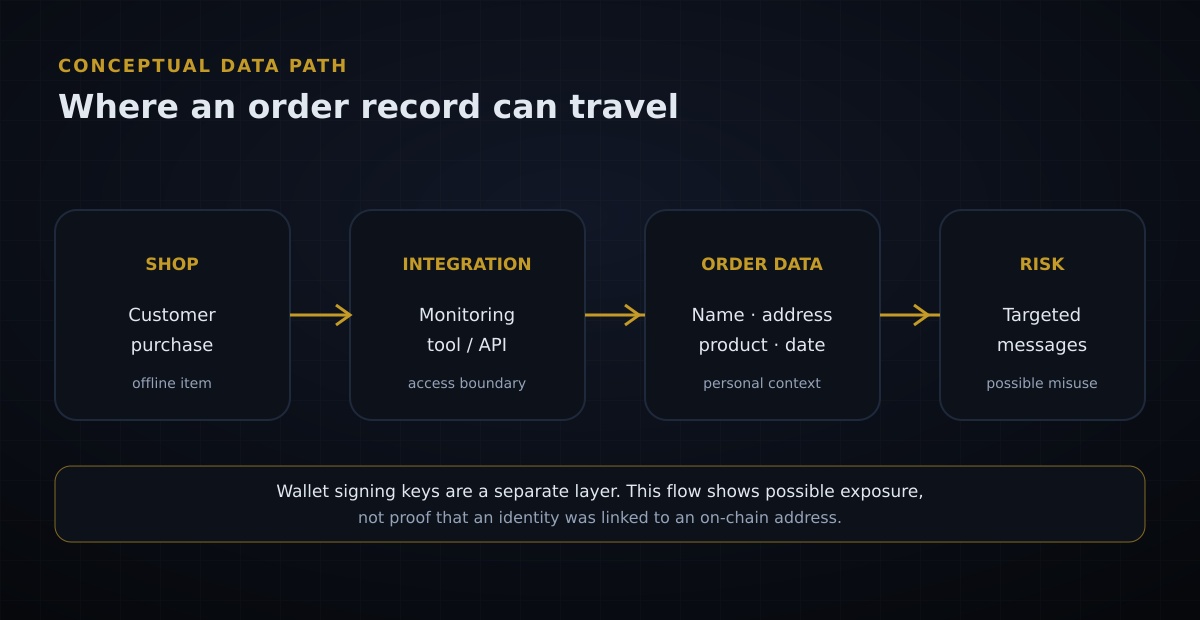
An API is a way for software to request data or actions from another system. A web shop may use APIs and connected tools to manage orders, monitor site activity, or process support requests. A credential or software vulnerability can therefore affect data outside the wallet's secure signing boundary. The details vary by system; the incident does not establish that every connected service had access to every customer field.
In this case, the reported chain joined a third-party monitoring tool, the website's access controls, and store records. The order data included identity and delivery details alongside a crypto-device purchase. That combination can create a high-value target for tailored phishing or social engineering. It does not by itself prove a criminal has used the information, but it explains why privacy engineering must account for connected services and retained data, not only wallet firmware.
The layers involved should not be confused:
- The store record describes a customer and a purchase.
- The device-authentication key supports a product authenticity check; it is not a wallet signing key.
- The blockchain record shows public transactions but does not name a customer on its own.
Metadata leakage and blockchain analytics
Metadata leakage occurs when information that looks unimportant in isolation becomes identifying in combination. A store can hold a name, address, product, and date. A public blockchain can show transaction times, amounts, and addresses. A service may separately record a visit or support interaction. If reliable identifiers connect those records, an observer may infer that a particular person owns a device or uses a service.
Blockchain analytics works from public or otherwise available transaction patterns. Some tools cluster addresses using heuristics, but a cluster is an inference, not proof that one person controls every address in it. A shipping record is also not a blockchain identity label. The analytical risk comes from correlation: more information can narrow a set of possible explanations, but the result depends on the quality, scope, and context of each dataset.
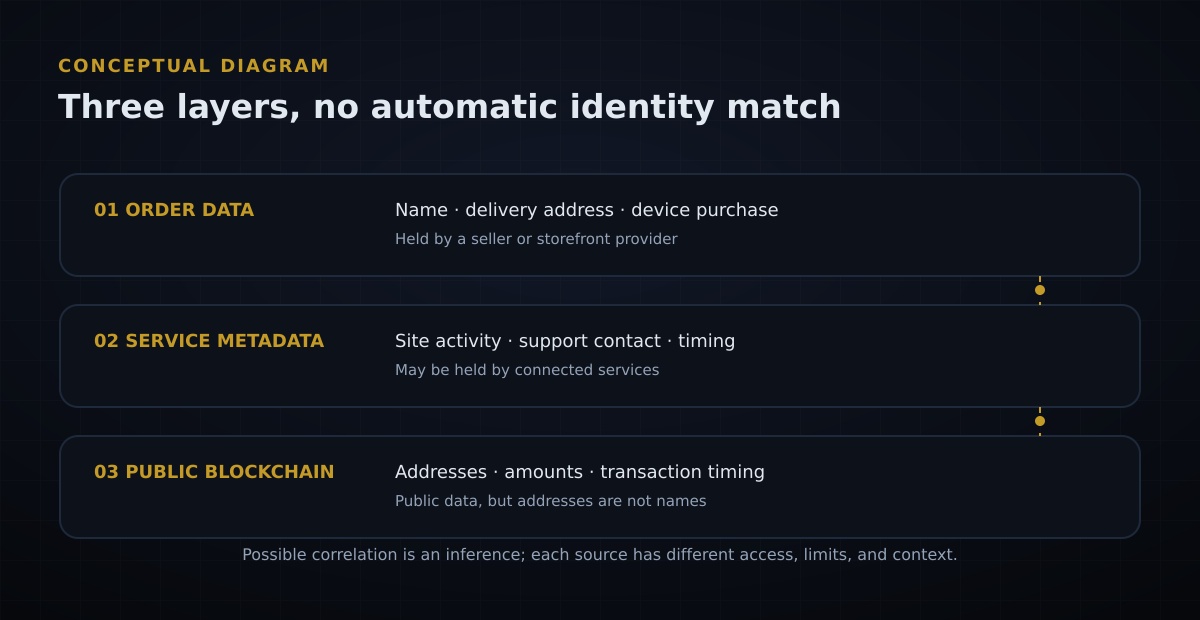
This distinction is important for financial surveillance. A company can improve its controls and reduce unnecessary collection, yet it cannot erase public ledger history. Conversely, visible blockchain activity does not make an offline shipping address public by itself. Privacy tools work best when they address a specific link in the chain rather than promise total anonymity.
Privacy erosion in digital finance is often cumulative
The political mechanism is not limited to a government watching transactions directly. Commercial services collect data to deliver products, prevent fraud, or support users. Vendors and integration partners may process parts of that data. Breach, retention failures, legal requests, or data sharing can then make previously separate records more accessible or linkable. This is analysis of how data systems interact; it is not evidence that Keystone's records were used for surveillance.
Operators can reduce avoidable exposure by limiting the data and access available at each layer:
- Give integrations only the permissions and fields needed for their function.
- Test automated deletion jobs and monitor failures rather than treating a published retention period as proof of deletion.
- Keep audit records that support investigation, and explain confirmed impact separately from unresolved questions.
The global legal setting also differs by jurisdiction:
- United States: Requirements depend on the organization, sector, and applicable state or federal law. The FTC's Safeguards Rule applies to covered financial institutions and requires protections for customer information; it also includes breach reporting for certain incidents. It should not be assumed to govern every wallet retailer (FTC, Safeguards Rule guide).
- European Union: GDPR Article 33 requires a controller to notify a supervisory authority within 72 hours when feasible if a personal-data breach is likely to risk people's rights and freedoms; Article 34 concerns communication to affected people when the risk is high (Regulation (EU) 2016/679).
- Canada: Organizations subject to PIPEDA must report and notify affected people when a breach creates a real risk of significant harm, and must keep records of breaches (Office of the Privacy Commissioner of Canada).
- Africa: There is no single continent-wide breach rule. South Africa's POPIA includes notification duties after a security compromise, subject to the Act's terms and facts of a case (South African Government, POPIA).
- Asia: Rules differ across countries. Singapore's Personal Data Protection Act and its breach-notification regulations set duties for covered organizations; the applicable threshold and timeline depend on the incident and the law (Singapore Statutes Online, breach-notification regulations).
These are not interchangeable standards, and this summary cannot determine which law applies to a particular customer or company. A public incident notice also does not establish that a regulator's notification threshold was met.
How non-custodial swaps protect users—and what they do not
Non-custodial swaps can reduce dependence on an intermediary that takes control of assets during a transaction. AnonSwap's published product information says users do not need to register an account or connect a wallet, and describes its swap service as non-custodial. That describes the product's account and custody model; it does not mean the service or every routing partner collects no metadata.
The boundary matters. A swap does not repair a breached storefront record, remove a shipping address from a seller's systems, or make a public blockchain private. Routing partners, the asset, transaction size, network providers, and local law can affect what a route requires or reveals. Users should evaluate privacy claims against the actual data path and current route terms rather than infer anonymity from the word “non-custodial.”
How Users Can Protect Themselves This Week
The most useful response is practical and proportionate:
- If you bought from Keystone's website during the affected period, use the company's official announcement and support channel to check its current guidance. Do not rely on unsolicited messages or links.
- Never provide a recovery phrase or private key to support staff, a replacement-device form, or a message claiming to verify a purchase. Keystone said those credentials were not involved in the incident.
- If an order record may have been exposed, be alert to messages that combine a real name, product, delivery detail, or purchase date. Verify the sender through a known site address before taking action.
- Ask services what they collect, which connected providers process it, how long it is retained, and how deletion failures are detected. A written retention period is useful only if the process is monitored.
- Separate custody questions from metadata questions. Before using privacy tools or non-custodial swaps, review the route, third-party terms, and blockchain visibility; do not assume any service can erase public records or override local requirements.
The Keystone disclosure illustrates a narrow but important point: keeping wallet keys offline does not automatically keep purchase data private. For operators, least-privilege access, limited retention, and verified deletion jobs reduce the data available to an attacker. For users, careful communication checks and realistic privacy expectations are stronger protections than panic—or an anonymity guarantee no product can substantiate.
Sources: Keystone, “Security Incident Update,” October 26, 2026; The Hacker News, October 27, 2026; Federal Trade Commission, Safeguards Rule guide; Regulation (EU) 2016/679; Office of the Privacy Commissioner of Canada; South African Government, POPIA; Singapore Statutes Online, breach-notification regulations. Checked November 4, 2026. This article is for informational purposes only and is not legal or financial advice.
Published November 4, 2026. Last updated November 4, 2026.
Frequently asked questions
What did Keystone disclose in October 2026?
Keystone said an attacker used a vulnerability in a third-party website data-monitoring tool to obtain customer information and a device-authentication key. Its October 26 update said 25,964 Shopify buyer records still held personal information.
Did the incident expose wallet recovery phrases or private keys?
Keystone said recovery phrases, wallet private keys, and wallet credentials were not involved. The disclosed information related to store orders and a key used to verify device authenticity.
How can an order record create metadata leakage?
A store record can connect a person to a physical crypto device. If combined with public transaction data or other leaked records, it may make ownership or activity easier to infer, even when the wallet itself remains uncompromised.
Do non-custodial swaps prevent financial surveillance?
No. Non-custodial swaps distinguish asset control, not every data flow. Storefronts, network services, routing partners, public ledgers, asset, transaction size, and local law can affect what is collected or visible.