
The API Key Behind the Spam: What Foundation’s Incident Means for Crypto Privacy
• 8 min read • by Kelvin Jones
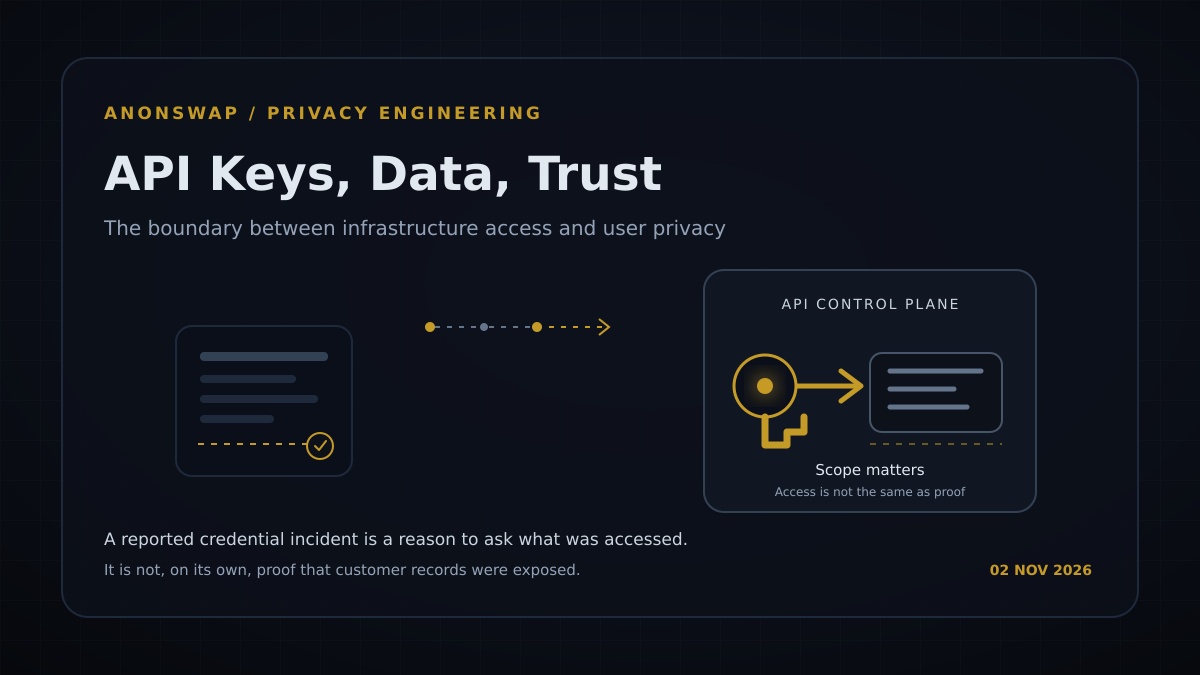
The API Key Behind the Spam: What Foundation’s Incident Means for Crypto Privacy
A security incident can reach a user without touching a blockchain. On October 26, Bitcoin hardware wallet maker Foundation said spam emails appeared to come from its official domains and traced the incident to one or more compromised Cloudflare API keys. It said it revoked the keys and took down the malicious domain. The disclosure puts API privacy in focus: a credential used to manage internet infrastructure can create a trust problem far beyond a website outage.
The limits of the public record matter just as much. Foundation’s post did not establish that its customer database was accessed. The next day, AMBCrypto reported that users were asking how personal details appeared in messages, including after some had requested deletion of their data. Those questions warrant a careful response, but they are not proof of a database breach. For crypto users, the distinction is a practical lesson in evidence, privacy engineering, and market psychology.
What Foundation disclosed—and what remains unconfirmed
Foundation’s October 26 statement said emails that appeared to originate from official company domains had been sent, that one or more Cloudflare API keys were compromised, that the keys had been revoked, and that the malicious domain linked to the spam had been taken down (FOUNDATION, October 26, 2026). Its announcement described an email and infrastructure incident. It did not publicly detail the keys’ permissions, the number of affected recipients, or whether any customer-record system was accessed.
AMBCrypto’s October 27 report covered questions from users who said messages contained personal details, including names and delivery information (AMBCrypto, October 27, 2026). That makes the unanswered data-handling questions newsworthy; it does not resolve them. A leaked or misused API credential can explain one part of an incident without explaining the source of every field in an email.
The careful summary is therefore narrow:
- The company reported a Cloudflare API-key compromise and remedial steps.
- Users raised questions about personal information in the spam messages.
- Public reporting reviewed here does not establish that a customer database was accessed or identify the source of that information.
This distinction protects readers from two opposite errors: assuming the incident was harmless because wallet funds were not reported affected, or assuming that every customer record was stolen because a message looked convincing.
Why an API key is a privacy boundary
An application programming interface (API) lets software request data or actions from another system. An API credential proves that a request is authorized. Depending on the credential type, configuration, and permissions, it may allow access to only a narrow task—or to a much broader set of controls. Cloudflare documents scoped API tokens as a way to limit permissions; the incident report does not say which permissions the compromised keys carried (Cloudflare, API tokens documentation).
For a company, the API control plane is not the same thing as its customer database. A credential connected to domain, DNS, or email-related configuration could be relevant to messages that appear to come from a company, but that does not by itself prove access to order history, identity documents, wallet recovery data, or any other customer record. Establishing that would require evidence about the affected systems, audit logs, and the actual scope of the credential.
Conceptual diagram. The reported API incident and customer-record access are separate questions; no forensic system map has been published.
The privacy-engineering response starts with least privilege: issue a credential only for the task it needs, restrict its permissions and lifetime, store it outside public code, rotate it when exposure is suspected, and preserve logs that can show what it did. Revoking a key is an important containment step, but a complete incident account should also explain what was investigated and what remains unknown.
The global regulatory lens
The incident is not a new crypto rule. It is a useful stress test for existing privacy and breach-response duties, which differ by jurisdiction and by the kind of organization and data involved. Crypto regulation and data-protection law can overlap, but they are not interchangeable.
The same caution applies to stablecoin policy: it does not establish that a stablecoin or blockchain was involved in this incident.
- United States: Breach-notification obligations depend on applicable state and sector rules. The Federal Trade Commission’s business guide recommends preparing a response plan and investigating what information was involved; it is guidance, not a single nationwide notification deadline (FTC, Data Breach Response Guide for Business).
- European Union: GDPR Article 33 generally requires a controller to notify its supervisory authority within 72 hours after becoming aware of a personal-data breach when the breach is likely to risk people’s rights and freedoms. Article 34 addresses communication to affected people when the risk is high (Regulation (EU) 2016/679, Articles 33–34).
- Canada: Under PIPEDA, an organization must report a breach to the federal Privacy Commissioner and notify affected individuals when there is a real risk of significant harm; organizations must also keep records of breaches (Office of the Privacy Commissioner of Canada, breach reporting).
- Africa: Requirements are national, not continental. South Africa’s Protection of Personal Information Act (POPIA), for example, contains a security-compromise notification provision; its application depends on the facts and the responsible party’s obligations (South African Government, POPIA).
- Asia: Rules also vary across countries. Singapore’s Personal Data Protection Act includes breach-notification provisions, illustrating why a provider’s location, users, and processing arrangements matter (Singapore Personal Data Protection Act 2012).
These frameworks do not let an outside observer infer whether a particular threshold was met. That depends on what data was involved, the likelihood and severity of harm, and the applicable law. A public company statement can be useful, but it is not a substitute for an investigation or a regulator’s determination.
Market psychology: fear needs a boundary
When a provider’s email domain is abused, a user can reasonably question whether a message is genuine. In crypto, that uncertainty can feel acute because attackers may imitate support staff, wallet alerts, or exchange notices. But a plausible-looking message is not proof of a wallet compromise, just as a revoked API key is not proof that customer records were untouched.
The disciplined response is to separate what is observed from what is inferred. Panic can lead people to click a “security” link, disclose a recovery phrase, or rush assets through an unfamiliar service. Overconfidence creates the opposite danger: dismissing personal-data exposure because on-chain balances remain visible and unchanged. Neither reaction improves privacy.
Conceptual diagram. Asset custody and personal-data exposure require separate evidence and response paths.
What users and operators should take from it
For operators, API privacy is an operational discipline, not a marketing label. Useful safeguards include:
- Use narrowly scoped, short-lived credentials and separate production access from routine development.
- Keep secrets out of source code and restrict who can issue, view, or revoke them.
- Monitor credential use, domain changes, and outbound email; retain evidence needed to investigate.
- Tell affected users what is confirmed, what systems were checked, what is still unknown, and how to verify legitimate communications.
For users, avoid relying on email alone when a message asks for a transaction, login, or recovery action. Go to a known official address independently, use the provider’s established support channel, and never enter a seed phrase or private key into a message-linked form. If a data deletion request was made, ask the provider what records were deleted, what may be retained under legal or operational requirements, and whether a later incident involved any of those systems.
Those steps are not a way to avoid financial surveillance or legal duties. They reduce avoidable exposure and help users evaluate the evidence without treating every privacy claim as a guarantee.
How non-custodial swaps protect users—and what they do not
Non-custodial swaps can reduce reliance on an intermediary that takes control of assets during a transaction. That is a meaningful custody distinction: users should understand which party controls funds, how a route is fulfilled, and what happens if a transaction fails. It is not a universal privacy shield.
A non-custodial interface can still rely on website infrastructure, analytics, email, network providers, or liquidity partners. Public blockchain records may remain visible, and a route can have its own eligibility or verification conditions. API privacy asks another question: which credentials and systems can access or change service data? Both questions matter, but one does not answer the other.
AnonSwap’s role in the privacy ecosystem should be described with the same precision. Non-custodial swaps may offer an alternative to handing custody to a centralized exchange, but users should check the current route details and provider terms. No swap service should be presented as making public ledger activity disappear, preventing every metadata trail, or removing local legal obligations.
The Privacy Outlook for the Week Ahead
Foundation’s October 26 disclosure is a timely reminder that privacy can hinge on a credential several layers away from a wallet. The verifiable facts point to a reported API-key compromise, domain-related spam, and remediation. They do not settle whether customer records were accessed or how personal details appeared in messages. Keep that boundary visible as more information emerges.
For crypto businesses, the next test is whether incident communication matches the evidence: explain credential scope, investigation coverage, data impact, and user guidance without overstating certainty. For users, separate asset custody from personal-data handling, verify communications through known channels, and judge privacy tools by their actual data flows. In global crypto markets, financial surveillance and security anxiety can amplify each other; clear facts and careful privacy engineering are more useful than a reflexive flight to any product labeled private.
Sources: FOUNDATION (@FoundationHQ), October 26, 2026; AMBCrypto, October 27, 2026; Cloudflare, API tokens documentation; FTC, Data Breach Response Guide for Business; Regulation (EU) 2016/679, Articles 33–34; Office of the Privacy Commissioner of Canada, breach reporting; South African Government, POPIA; Singapore Personal Data Protection Act 2012. Checked November 2, 2026. This article is for informational purposes only and is not legal or financial advice.
Published November 2, 2026. Last updated November 2, 2026.
Frequently asked questions
What happened in Foundation’s October 26 announcement?
Foundation said spam emails appeared to come from its official domains, traced the issue to one or more compromised Cloudflare API keys, revoked the keys, and took down the malicious domain.
Does a compromised Cloudflare API key prove that customer data was stolen?
No. The public announcement did not establish access to Foundation’s customer database. A report the next day described user questions about personal details in messages, but those questions do not prove how the information was obtained.
Can non-custodial swaps prevent API or email data exposure?
No. Non-custodial describes who controls assets during a service interaction. It does not prevent exposure through email, website infrastructure, a provider’s records, public blockchains, or third-party APIs.
What can crypto users learn from the incident?
Separate wallet security from personal-data security, use strong account protections, and look for clear information about what a provider collects, which third parties it uses, and how it responds to incidents.