
The “Everlasting Security” Claim—and the Wallet Metadata It Cannot Hide
• 8 min read • by Kelvin Jones
The “Everlasting Security” Claim—and the Wallet Metadata It Cannot Hide
Quantum cryptography can promise a kind of security that ordinary and post-quantum cryptography do not—but that promise applies to a communication channel, not to every record surrounding a financial transaction. On November 6, 2026, Scientific Reports published “Quantum resources for everlasting communication security.” Its abstract describes quantum cryptography as offering “everlasting” security, a property unavailable through classical or post-quantum cryptography. That is a research development, not a finding that a consumer wallet, swap service, or public blockchain has become quantum-secure.
Encryption is not a privacy cloak: a message can be protected while its timing, route, account, network address, or related public transaction remains visible. Monday’s vendor-readiness coverage addressed migration; this article focuses on information encryption does not cover.
What the new study does—and does not—establish
The November 6 paper focuses on quantum resources and communication security. The central claim in its abstract is narrow: quantum cryptography can offer “everlasting” security, unlike classical cryptography and post-quantum cryptography, and conventional claims of that kind have historically relied on quantum principles such as no-cloning (Scientific Reports, November 6, 2026).
That claim should not be turned into a product announcement. The paper does not establish that quantum communication is in use by AnonSwap, that wallet transactions have become private, or that a user’s messages are immune to every form of observation. Nor does it mean current encryption is broken. NIST’s October 2026 transition report describes a planned migration from quantum-vulnerable public-key cryptography to post-quantum signatures and key-establishment schemes; that is a long-term standards transition, not evidence that a capable quantum computer is decrypting ordinary traffic today (NIST, NIST IR 8547, October 2026).
The point for users is to keep three different questions separate:
- What is encrypted? Message content, stored files, a connection, or something else?
- Who can observe surrounding data? A device, service, network operator, route partner, or public ledger?
- What does the security claim depend on? A mathematical assumption, a physical property, correct implementation, or an operational process?
The phrase “everlasting security” describes a goal in a defined cryptographic setting. It does not mean that identity, metadata, endpoints, or transaction history disappear.
Encryption protects a channel, not every layer
Encryption changes what an observer can read from protected data. It does not automatically remove the fact that data was sent, which service handled it, or how a public financial network records a transfer. End-to-end encryption can keep message content unreadable to the service that relays it, but a service may still need routing information to deliver the message. Signal’s explanation of its sealed-sender design explicitly distinguishes encrypted message contents from sender and recipient metadata, and describes efforts to reduce the service’s access to that metadata (Signal, October 29, 2018).
The same boundary matters in digital finance. A web connection to a swap interface may be encrypted in transit, while a blockchain records transaction data according to its protocol. Bitcoin.org describes Bitcoin transactions as public, traceable, and permanently stored; it also notes that IP addresses can be logged by network participants (Bitcoin.org, “Protect your privacy,” accessed November 11, 2026). These are different data planes. Better encryption for one does not erase the other.
Conceptual diagram: protected content and observable records. The diagram separates an encrypted service connection from metadata and public ledger activity; it does not depict a specific provider or route.
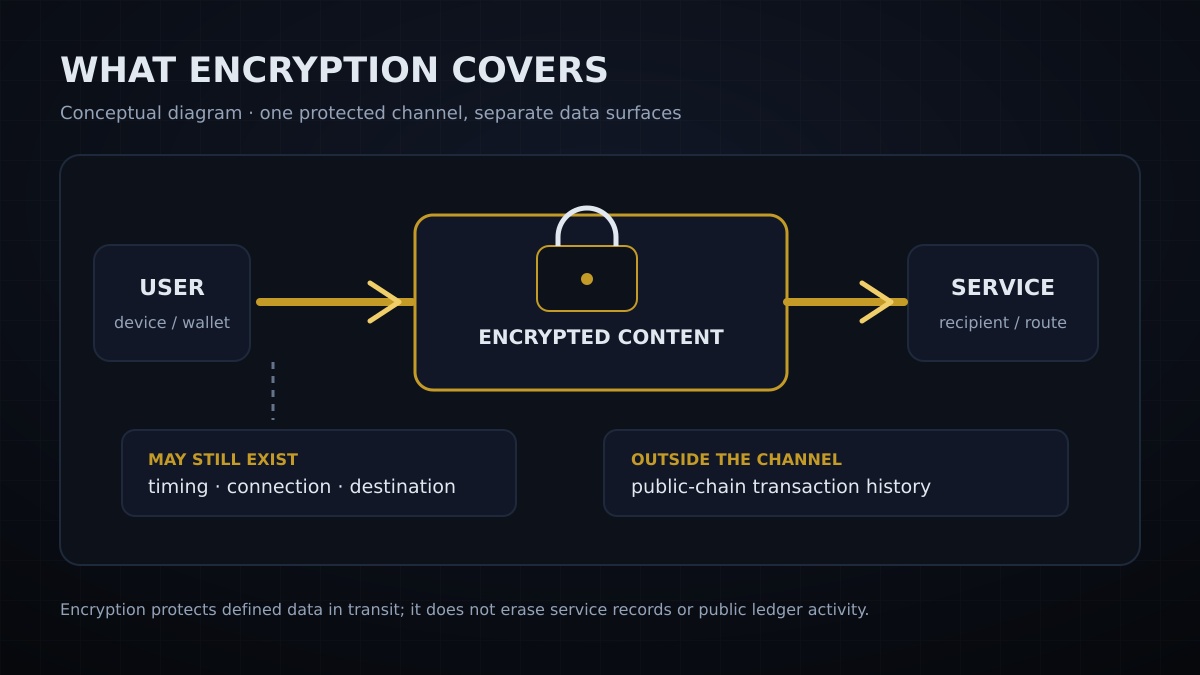
This distinction also clarifies the difference between security and privacy. A secure channel can prevent passive interception of message contents, while privacy depends on what the system collects, retains, shares, or publishes. A service can use strong encryption and still have a detailed account record. A public ledger can reveal transaction relationships even when the user’s messages to a service are encrypted.
Metadata leakage and blockchain analytics
Metadata is information about an interaction rather than its protected content: timing, destination, connection details, request size, or an account identifier. Which fields exist depends on the system. Those fields may be useful for routing, abuse prevention, support, or compliance, but they can also help connect events when retained or combined.
- Connection data: when a service is contacted and which network path carries the request.
- Service records: account or request details a provider needs for a defined operation.
- On-chain records: transaction details made visible by the public network's design.
Blockchain analytics adds another layer. Public ledgers expose transaction records; analytics may use patterns in those records to infer relationships between addresses. Such an inference is not the same as proving a person’s identity, and conclusions can be incomplete or wrong. But when an address is linked elsewhere to a name, purchase, or account, public transaction history can become more revealing. This is financial surveillance through correlation, not a failure of encryption.
Conceptual diagram: three separate data surfaces. The labels distinguish private content, operational metadata, and public chain data. They are illustrative, not a claim about a particular service’s logs.
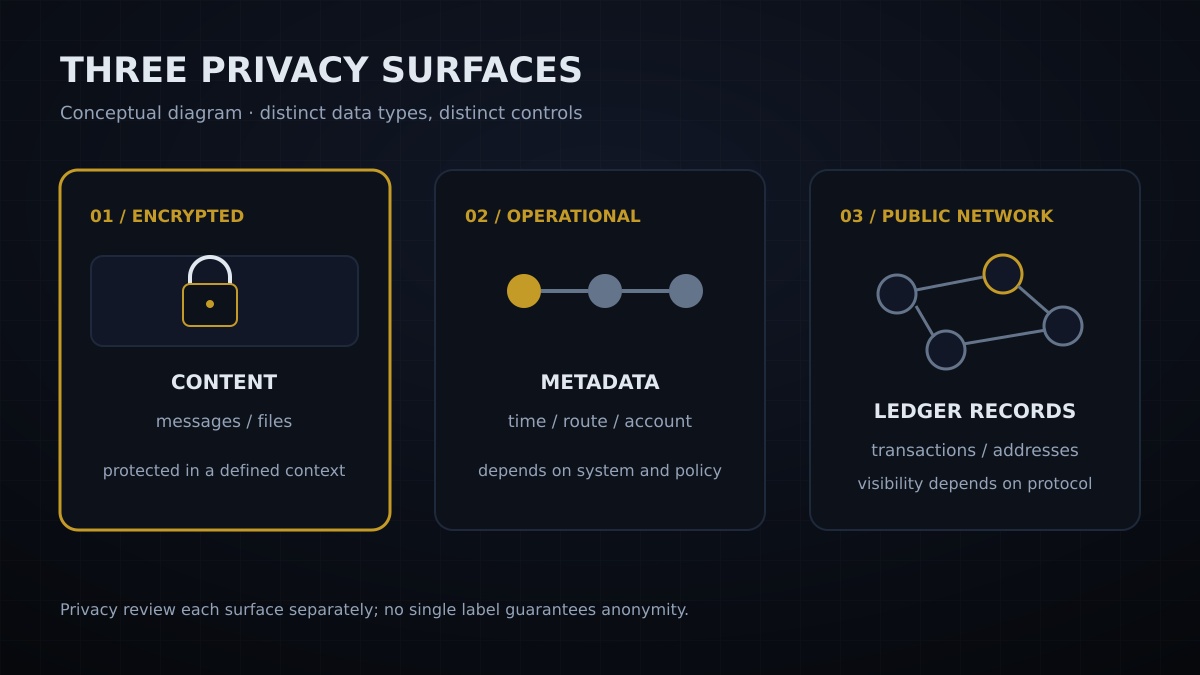
For a user, the useful questions are concrete: Is a wallet address published on a public page? Does a service require an account? Which third parties participate in a route? What does the provider say it stores? No single answer establishes that a transaction is anonymous. A privacy review should treat each source of data separately rather than assume that one security label protects the complete interaction.
Global policy: shared concern, different instruments
The quantum transition is international, but jurisdictions are not using one common timetable or legal instrument. These examples show why global digital rights and privacy assessments need carefully scoped claims.
| Region | Verified reference point | Scope |
|---|---|---|
| United States | NIST IR 8547 describes the U.S. standards transition to post-quantum cryptography. | A federal standards plan is not automatically a deadline for every private wallet or exchange. |
| European Union | Commission Recommendation (EU) 2024/1101 calls for a coordinated roadmap for transitioning to post-quantum cryptography. | It is a recommendation, not a new universal crypto-service licensing rule. |
| Canada | The Cyber Centre’s 2025 roadmap sets milestones for non-classified Government of Canada systems, including high-priority systems by the end of 2031 and remaining systems by the end of 2035. | The schedule covers federal government systems, not every Canadian business or resident. |
| Africa | The African Union’s 2014 Convention on Cyber Security and Personal Data Protection addresses cybersecurity and personal-data protection. | A continental treaty framework should not be mistaken for one region-wide post-quantum migration deadline. |
| Asia | Singapore’s 2026 Cyber Security Agency handbook and readiness index help organizations prepare for quantum-safe migration. | The guidance is Singapore-specific; it does not establish a shared schedule for all Asian jurisdictions. |
These are different kinds of sources: a technical standards report, a commission recommendation, a government migration plan, a regional convention, and national readiness guidance. Their dates and scopes matter. Encryption policy can influence procurement and provider practices, but it does not itself tell a crypto user whether a specific route collects network metadata or whether a particular ledger reveals transaction details. Sources: NIST, October 2026; European Commission, April 11, 2024; Canadian Centre for Cyber Security, June 23, 2025; African Union, Convention on Cyber Security and Personal Data Protection, 2014; Singapore CSA, July 16, 2026.
Privacy erosion in digital finance
Digital finance creates records during service use, network connections, identity checks where required, and public-chain settlement. Each has distinct access and retention rules. Encryption may protect a connection or stored data, but cannot make a public record private after the fact or stop every endpoint from recording an event.
That is why privacy-maximalist claims deserve scrutiny. “Encrypted,” “non-custodial,” and “no account required” describe different properties. Encryption describes protection of data in a defined context. Non-custodial describes who controls assets. An account requirement describes an interface or service condition. None by itself guarantees that no metadata is processed or that a public transaction cannot be analyzed.
The strongest practical approach is to reduce unnecessary data at the source, understand which parties handle a transaction, and avoid reusing public identifiers where the network and wallet support separate addresses. These steps can reduce some connections; they do not erase prior activity or guarantee anonymity.
How non-custodial swaps protect users—and their limits
Non-custodial swaps can reduce reliance on a platform that holds a customer balance. AnonSwap’s published service materials describe its swaps as non-custodial and say users can transact without creating an account. This is a limited claim about the service’s account and custody model, not an assurance that every route is metadata-free.
The asset, transaction size, routing partners, network, and local law can affect what a swap requires. Public-ledger visibility also remains a separate issue. A non-custodial interface may reduce the need to leave funds with a centralized account provider, but it cannot hide transaction data written to a public chain or guarantee that a route partner never processes operational information.
When evaluating a service, look for a clear explanation of custody, data collection, third-party participation, and any verification requirements. Consider whether an account is needed for the action you plan to take, and check the route’s terms before sending assets. Do not equate fewer account details with “anonymous,” and do not assume that quantum cryptography or post-quantum migration protects data outside the system where it is implemented.
How Users Can Protect Themselves This Week
The November 6 study is a reason to understand what a security claim covers, not to panic or move assets abruptly:
- Separate message secrecy from transaction privacy. Identify what is encrypted, what is public on-chain, and what service or network metadata may exist.
- Read claims precisely. Distinguish research findings, standards guidance, deployed product features, and a provider’s migration plan.
- Limit unnecessary exposure. Avoid posting wallet addresses alongside personal details, and review whether a service asks for information beyond what your transaction requires.
- Check custody and route details. Read current service terms, identify whether a route partner is involved, and remember that asset, amount, and local rules can change requirements.
- Treat privacy tools as risk reduction, not guarantees. Encryption and non-custodial swaps can address particular exposures; neither erases public records or ensures anonymity.
The useful lesson is not that “everlasting” encryption will make financial surveillance disappear. It is that privacy depends on boundaries: what cryptography protects, what a system collects, and what a public ledger reveals. As quantum-safe standards develop, users should ask more specific questions about each layer—and keep their claims about privacy as carefully scoped as the cryptography itself.
Sources: Scientific Reports, “Quantum resources for everlasting communication security,” November 6, 2026; NIST IR 8547, October 2026; Signal, “Technology preview: Sealed sender for Signal,” October 29, 2018; Bitcoin.org, “Protect your privacy,” accessed November 11, 2026; European Commission Recommendation (EU) 2024/1101, April 11, 2024; Canadian Centre for Cyber Security roadmap, June 23, 2025; African Union Convention on Cyber Security and Personal Data Protection, 2014; Singapore CSA Quantum-Safe Migration Handbook, July 16, 2026. This article is for informational purposes only and is not legal or financial advice.
Published November 11, 2026. Last updated November 11, 2026.
Frequently asked questions
What did the November 6 quantum-cryptography study find?
Scientific Reports published a study about quantum resources and communication security. Its abstract describes quantum cryptography as offering an 'everlasting' security property that classical and post-quantum cryptography cannot provide. The paper is not evidence that a consumer wallet or blockchain has adopted quantum cryptography.
Does encryption hide blockchain transactions?
No. Encryption can protect information in a specific communication or storage context. Public blockchain records remain visible according to the network's design, and services may also process metadata.
Do non-custodial swaps eliminate metadata leakage?
No. Non-custodial describes asset control. It does not conceal public-ledger activity or prevent network, service, or routing-partner metadata from being processed.
What is a practical privacy step for crypto users?
Separate the data you share with a service from what the public network records. Review service and partner disclosures, avoid unnecessary account information, and do not treat encryption or a no-account interface as an anonymity guarantee.