
The Encryption Clock Is Ticking: Crypto Privacy Starts With Vendors
• 8 min read • by Kelvin Jones
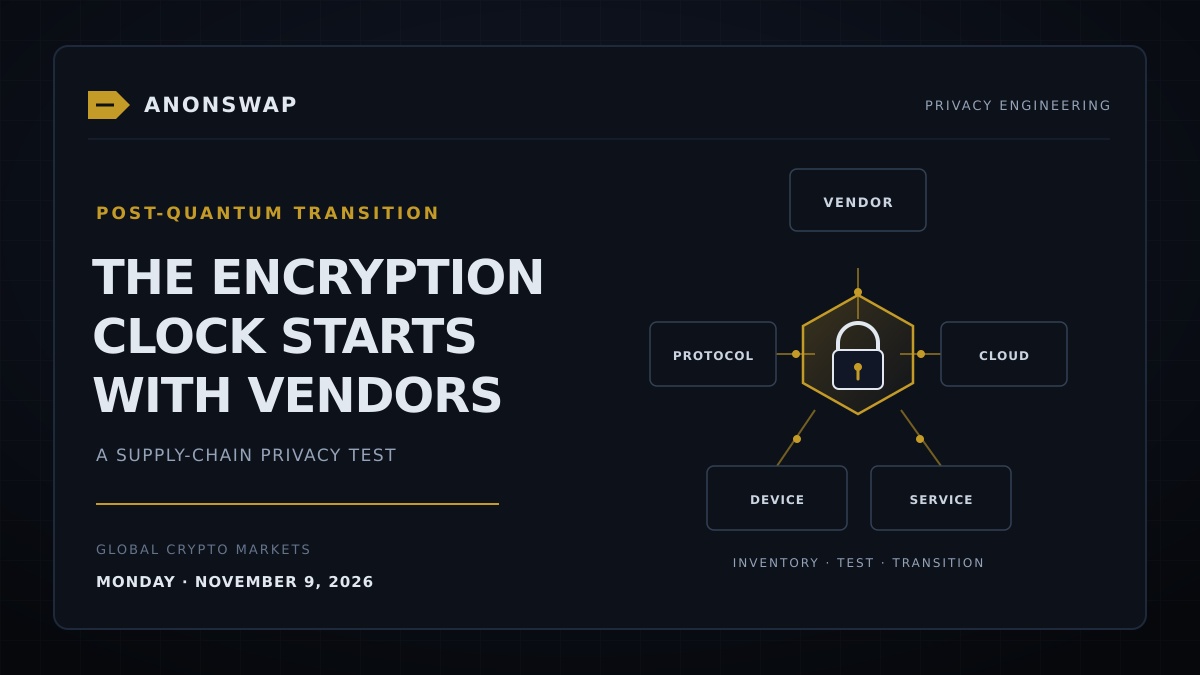
The Encryption Clock Is Ticking: Crypto Privacy Starts With Vendors
The next major encryption transition may depend less on a single new algorithm than on whether the vendors behind everyday services can inventory, replace, and test the cryptography they use. On November 5, 2026, Australia’s Australian Cyber Security Centre said it had updated its post-quantum vendor-readiness guidance with the United States’ Cybersecurity and Infrastructure Security Agency (CISA) and National Security Agency (NSA). The guide is aimed at procurement, contract renewals, and continuing vendor assurance—not at declaring that today’s encryption has been broken.
That distinction matters for crypto users. A swap app, wallet, exchange, cloud platform, or messaging service can rely on many suppliers and protocols. Users usually cannot see which cryptographic components protect a connection or how quickly a provider can update them. The recent guide puts that supply chain in view, making encryption migration a privacy-engineering and regulatory-coordination issue as well as a technical one.
What changed—and what the announcement does not say
The Australian Cyber Security Centre’s November 5 notice says the updated guide was developed with CISA and NSA. Its companion publication, Post-quantum questions to ask your vendors, was first published in July and was reviewed on November 5. It organizes vendor discussions around locating cryptographic dependencies, assessing risks, prioritizing systems, implementing post-quantum cryptography (PQC), and communicating with suppliers (ASD’s ACSC, November 5, 2026; ASD’s ACSC, guide, first published July 16 and reviewed November 5, 2026).
This is a practical update to transition guidance, not a new legal deadline for every crypto business. It does not announce a newly discovered break in encryption, certify any particular vendor, or establish that a company has completed its migration. Its significance is that public agencies are treating supplier readiness as an operational dependency: a buyer’s own plan can be delayed by software, hardware, cloud, or network products it does not build itself.
For readers assessing a public claim, separate three things:
- Current posture: what algorithms and products the provider uses now.
- Migration plan: which systems will change, in what order, and how testing is handled.
- Regulatory status: whether a date is advice, a procurement condition, or an enforceable obligation.
Post-quantum cryptography is designed to resist attacks from both conventional and sufficiently capable quantum computers. NIST’s finalized NISTIR 8547 explains how its standards transition away from algorithms considered vulnerable to future quantum computers. The agency stresses that timelines differ by use case and that organizations must consider their cryptographic supply chains (NIST, October 27, 2026; updated November 2).
Why vendor readiness is a privacy boundary
Encryption is not one switch. Public-key methods help establish keys and authenticate systems; symmetric algorithms commonly protect the bulk data after a secure session is established. PQC migration therefore involves algorithms, software libraries, protocols, certificates, devices, and supplier release cycles. A provider may have a sound plan on paper but still depend on a product that cannot yet support the required transition.
The privacy consequence is broader than whether a transaction is visible on a blockchain. Long-lived private information—account communications, identity records, business correspondence, or stored financial data—could be more exposed if it was captured while protected by vulnerable cryptography and later decrypted by a future capable system. That “collect now, decrypt later” concern is a reason to plan carefully, not proof that such decryption is possible today. The Canadian Cyber Centre says existing quantum computers are not powerful enough to break current cryptography (Canadian Centre for Cyber Security, February 2025).
Conceptual diagram: the migration chain. The layers below are examples of questions raised by the ASD’s ACSC guide and NIST’s migration report; they are not a claim that any one service has a specific weakness.
| Layer | Readiness question | Privacy relevance |
|---|---|---|
| Vendor inventory | Where are public-key algorithms and certificates used? | Unknown dependencies can leave sensitive data protected by older methods. |
| Product and protocol | Can the supplier update the implementation and interoperate with customers? | A migration can fail at a boundary between otherwise secure systems. |
| Deployment and monitoring | Is the change tested, staged, and maintained? | A rushed or partial rollout can create downtime or inconsistent protection. |
Global rules are converging on planning, not one shared deadline
The November update is international, but it does not make national policy identical. The distinctions matter for global crypto markets: an agency recommendation, a government migration schedule, a technical standard, and a binding law have different reach.
This is not a stablecoin policy change, and it does not create a new crypto licensing requirement. It is still relevant to the broader market because a provider may use common technology suppliers across multiple products and jurisdictions.
| Region | Public reference point | What it means—and what it does not |
|---|---|---|
| United States | NISTIR 8547 describes federal migration timelines; NIST says Executive Order 14412 accelerates key-establishment migration for high-value federal systems to 2030 and digital signatures to 2031. | A federal schedule informs suppliers and contractors, but it is not automatically a deadline for every private wallet or exchange. |
| European Union | Commission Recommendation (EU) 2024/1101 calls for a coordinated roadmap for transition to PQC. | It is a recommendation for coordinated implementation, not a single new EU-wide crypto-service licensing rule. |
| Canada | The Cyber Centre’s Government of Canada roadmap sets departmental milestones, including high-priority systems by 2031 and remaining systems by 2035. | The cited milestones concern Government of Canada systems, not every Canadian business or user. |
| Africa | The African Union’s October 2026 ICT session covered digital policy, cybersecurity, and personal-data protection. Its notice does not set a continent-wide PQC deadline. | A continental digital agenda should not be mistaken for an encryption mandate adopted by every member state. |
| Asia | Singapore’s Cyber Security Agency provides a Quantum-Safe Handbook and a readiness self-assessment for organizations, especially critical-infrastructure owners and government agencies. | It supports preparation; it is not evidence that all Asian jurisdictions share one migration schedule. |
Conceptual comparison, not a legal survey. Sources: European Commission, Recommendation (EU) 2024/1101, April 11, 2024; Canadian Centre for Cyber Security, Government of Canada roadmap, June 23, 2025; African Union, digital-transformation and ICT session notice, October 20, 2026; Singapore Cyber Security Agency, Quantum-Safe Handbook and Quantum Readiness Index.
For consumers, this regulatory patchwork means a service can be subject to different procurement expectations and transition plans across markets. It does not mean users should infer that a particular wallet, swap route, or stablecoin is unsafe because it has not announced a PQC milestone. Public disclosures are uneven, and technical readiness cannot be established from a marketing label.
Market psychology: avoid both panic and complacency
The word “quantum” can turn a long engineering program into a false market countdown. The opposite mistake is to treat a future-facing threat as irrelevant until a breakthrough is announced. Both reactions can distort decisions about crypto regulation, financial surveillance, and personal privacy.
- Fear can overstate immediacy. Guidance about migration does not mean current encrypted sessions are being routinely decrypted.
- Complacency can ignore data lifetime. Information that must remain confidential for years may deserve earlier attention than short-lived data.
- Herd behavior can reward slogans. A vendor saying “quantum-safe” is not equivalent to a documented inventory, tested upgrade path, and maintained supplier commitments.
The macro signal is about spending and coordination. Governments, financial institutions, and technology suppliers must plan staff time, testing, procurement, and product lifecycles across jurisdictions. Those costs and timelines can affect resilience and trust, but this guidance alone does not establish a near-term price catalyst for Bitcoin or other assets.
What crypto users can reasonably check
Users do not need to audit cryptographic code to ask useful questions. Look for precise statements about systems and migration scope rather than broad claims of being “future-proof.”
- Does the provider distinguish its current encryption from a planned PQC transition?
- Does it say whether its vendor and protocol dependencies are being assessed?
- Are dates described as targets, contractual obligations, or completed work?
- Does its privacy notice explain what data is retained, independently of encryption?
These are due-diligence questions, not a test that can prove a service secure. Do not send private keys, recovery phrases, account identifiers, or sensitive records to a provider merely to ask about its plans.
Privacy implications for non-custodial swaps
Non-custodial swaps address one important boundary: who holds or controls assets during the exchange. They do not decide whether a device is patched, how a browser resolves a connection, what a service or route partner logs, or which details appear on a public blockchain. Encryption protects data in defined contexts; it does not make public transaction history confidential.
For users, this means privacy is layered. A service can reduce the need for a custodial account while still relying on web infrastructure, suppliers, and networks that require sound cryptographic maintenance. Conversely, upgrading a website’s encryption does not conceal on-chain activity or undo information previously collected by another service. These are related safeguards, not substitutes for one another.
AnonSwap’s role should be understood within that limit. AnonSwap’s own FAQ describes the service as non-custodial and says registration is not required. That model is relevant to asset control, but it cannot eliminate public-ledger visibility or guarantee that every network and supplier has completed a PQC transition. This article does not claim that AnonSwap or any other named swap provider has completed such a migration. The useful standard is transparent, verifiable information about custody, data handling, and security updates—not an unsupported promise of total anonymity.
The Privacy Outlook for the Week Ahead
The November 5 update is a reminder that encryption resilience depends on procurement as much as algorithms. Watch for vendors to publish scoped migration plans, for regulators to distinguish recommendations from enforceable requirements, and for providers to explain which systems and data their plans cover. Do not mistake preparation for evidence of a current cryptographic break.
For everyday crypto users, the practical privacy question remains concrete: what data is collected, who controls the assets, which third parties are involved, and how does the service maintain the systems that protect communications? Non-custodial swaps and other privacy tools can reduce some exposures, but they work within a wider technical and legal environment. A careful reading of vendor commitments is more useful than either panic about quantum headlines or blanket assurances that today’s protections never need to change.
Sources: ASD’s ACSC, “Updated guidance supports vendor talks on post-quantum cryptography,” November 5, 2026; ASD’s ACSC, “Post-quantum questions to ask your vendors,” first published July 16 and reviewed November 5, 2026; NIST, “NIST Report Provides Guidelines for Transition to Post-Quantum Cryptography Standards,” October 27, 2026, updated November 2; Canadian Centre for Cyber Security, “Preparing your organization for the quantum threat to cryptography,” February 2025; European Commission, Recommendation (EU) 2024/1101, April 11, 2024; Canadian Centre for Cyber Security, Government of Canada PQC roadmap, June 23, 2025; African Union, digital-transformation and ICT session notice, October 20, 2026; Singapore Cyber Security Agency, “Quantum-Safe Handbook and Quantum Readiness Index,” publication page; AnonSwap, FAQ. Checked November 9, 2026. This article is for informational purposes only and is not legal or financial advice.
Published November 9, 2026. Last updated November 9, 2026.
Frequently asked questions
What changed in post-quantum guidance on November 5, 2026?
Australia’s Australian Cyber Security Centre said it had updated vendor-readiness guidance in partnership with the U.S. CISA and NSA. The guide helps organizations assess cryptographic dependencies and vendor migration plans; it is guidance, not a new encryption standard or a new law.
Can a quantum computer currently decrypt crypto users’ information?
The cited Canadian Cyber Centre guidance says existing quantum computers are not powerful enough to break current cryptography. Post-quantum migration is preparation for a future capability, not evidence that current encryption has already failed.
Does post-quantum encryption make blockchain transactions private?
No. Post-quantum cryptography aims to protect cryptographic operations against future quantum-capable attacks. Public transaction data remains public unless a protocol separately provides privacy features.
Do non-custodial swaps remove every privacy risk?
No. Non-custodial describes asset control. It does not prevent network metadata collection, service or partner records, public-ledger visibility, or applicable legal requirements.