
The Network Isolation Test: Who Can Link Your Wallet Requests?
• 7 min read • by Kelvin Jones
The Network Isolation Test: Who Can Link Your Wallet Requests?
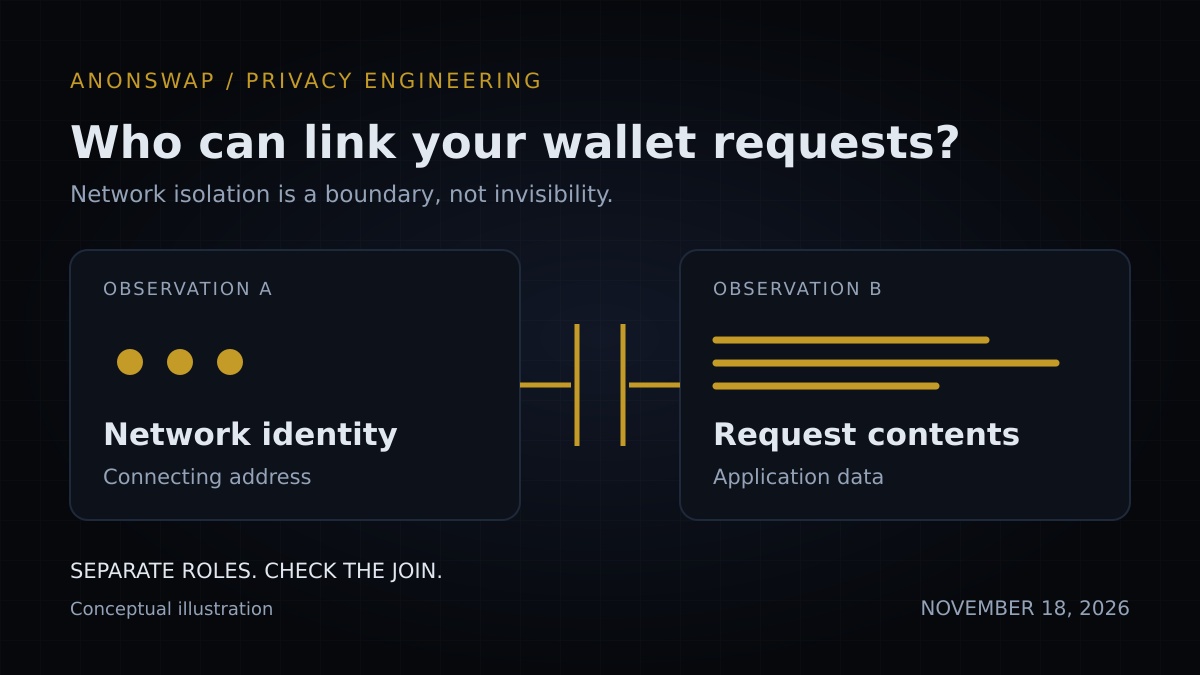
Your wallet request can be encrypted and still arrive with a revealing return address. Hide that address, and the request itself may still contain an account identifier or a recognizable browser fingerprint. The surveillance opportunity is not just reading a message: it is joining records that were supposed to stay separate.
On November 10, 2026, Mozilla described browser-fingerprinting research that also used Oblivious HTTP, or OHTTP, to separate participants' IP addresses from study request contents. That is a concrete Network Isolation lesson within this month's Privacy Engineering theme. Monday's Mozilla study and crypto metadata analysis covered the broader regulatory and behavioral stakes. Here, the test is technical: which participant can connect your network identity to what you requested?
What changed: a documented separation, not a new anonymity promise
Mozilla's November 10 Security Blog publication reports measurements from nearly 25 million Firefox users. The study investigated browser fingerprinting: combining device and browser characteristics to distinguish visitors, including without cookies. Mozilla says its findings informed protections that reduce distinguishing details. These are the publisher's research and product claims, not an independent audit of every tracking technique.
The collection safeguards matter separately. Mozilla says a relay received encrypted requests and could see participants' IP addresses without reading the contents. Mozilla received the contents without those addresses. It also reports deleting individual telemetry records several months before publication and retaining aggregate results. The November development is this research account, not the invention of OHTTP.
For users, three questions turn that example into an assessment:
- Separation: are connection information and readable request contents handled by different roles?
- Linkability: does the payload contain an identifier that reconnects those roles' observations?
- Governance: can shared operators, logs, or retention practices undermine the separation?
Network isolation is a trust boundary
IETF RFC 9458, January 2024, specifies OHTTP. A supported client encrypts an HTTP request for a gateway and sends it through a relay. The gateway decrypts the request and handles delivery to the target service. The relay can forward the message without reading its protected contents; the gateway receives the relay's connection rather than the client's original network address.
This is not the same as ordinary HTTPS. Transport encryption protects a connection's contents from intermediaries, but a directly contacted endpoint still receives the connecting address. OHTTP adds message protection across the relay and separates who sees which information. A VPN changes another network boundary; it does not automatically implement OHTTP or remove application identifiers.
Conceptual diagram: role visibility, not a deployment claim. The gateway and target can be operated together. The separation depends on the relay not colluding with the gateway.
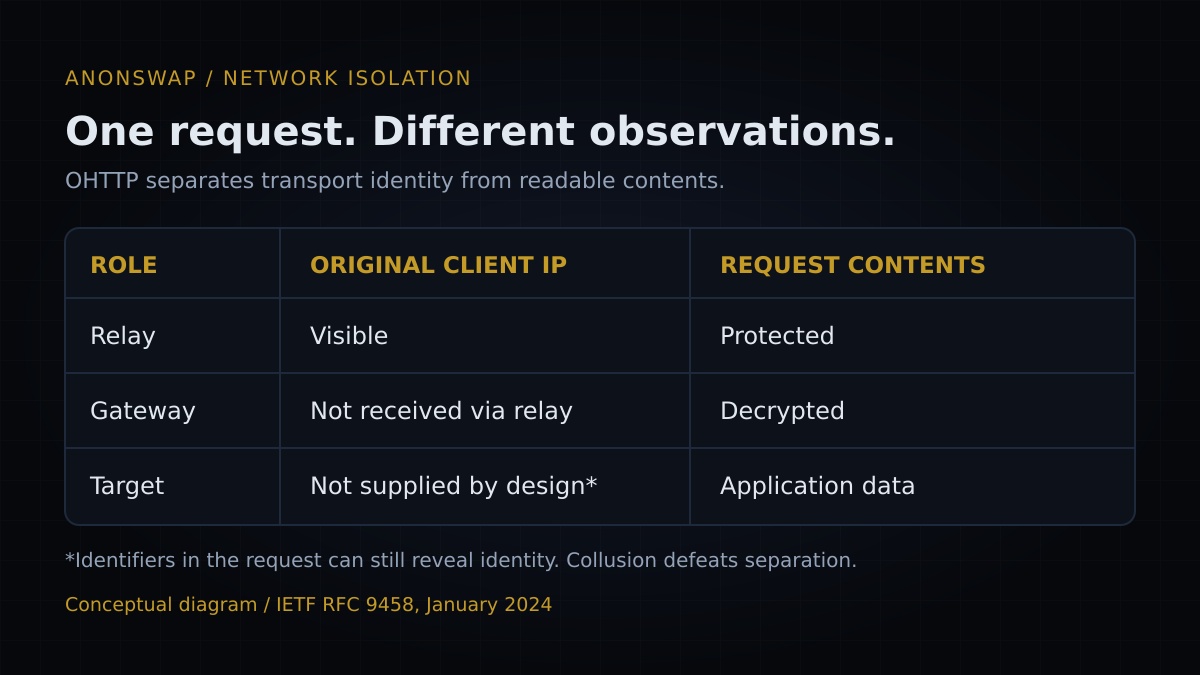
RFC 9458's security considerations explain why operational independence matters. Colluding relay and gateway operators can combine observations. Request contents can identify a client even when transport identifiers are absent. Traffic analysis also remains relevant. Network isolation reduces a defined correlation opportunity under stated assumptions; it is not protection against every observer.
Do not assume your wallet, swap interface, or browser traffic uses this architecture because Mozilla used it for a study. OHTTP needs application support. Nothing in that publication establishes that AnonSwap implements it.
Metadata leakage and blockchain analytics
The network address is one identifier, not the entire privacy model. A request can carry a wallet address or order reference. Reusing an account identifier can reconnect otherwise separated sessions. Browser fingerprinting addresses yet another layer: Mozilla describes combinations of fonts, screen characteristics, and hardware-related signals that distinguish browsers.
For Bitcoin, Bitcoin.org's privacy guidance, checked November 18, explains that transactions are public and permanently recorded, and that publishing addresses or purchase details can expose associations. It also cautions that a node observed relaying a transaction is not necessarily its origin. Observation should not be confused with proof of identity.
Blockchain analytics can examine public transaction relationships; attributing them to a person is a separate evidentiary step. In a conceptual example, voluntarily publishing a receiving address supplies a link that hiding an IP address cannot undo. This is a risk model, not an allegation that a particular provider performs that analysis.
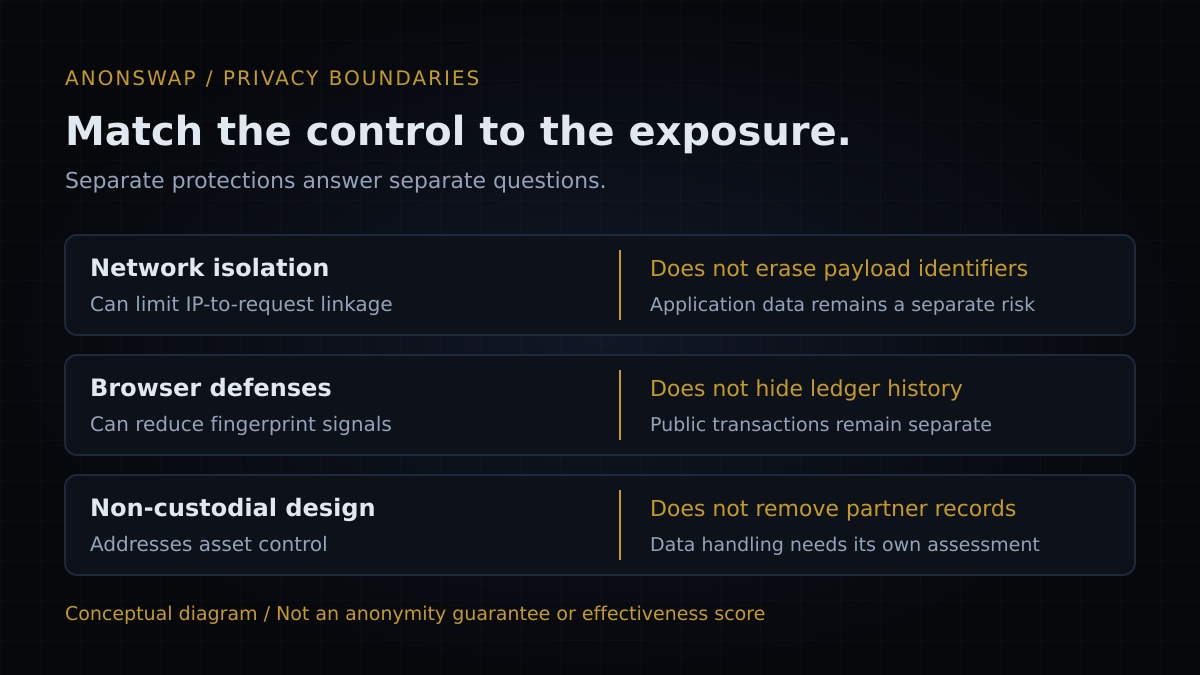
- Network records concern connections, addresses, and timing.
- Application records concern requests, identifiers, and information supplied to services.
- Ledger records follow the asset network's visibility rules; Bitcoin's rules do not describe every asset.
Conceptual diagram: controls have different coverage. No row promises anonymity or represents a measured effectiveness score.
Privacy erosion in digital finance
The political mechanism of financial surveillance is the concentration of linkable information. A service that holds identity records and financial activity has a different observation position from one that processes a narrowly scoped request. Retaining unnecessary data expands what could later be exposed through a breach, internal misuse, or lawful disclosure. This is architectural analysis, not a claim about a new legal power or a documented AnonSwap incident.
Data minimization therefore complements encryption. Separating roles while keeping indefinitely joinable logs can weaken the intended boundary. Conversely, reducing unnecessary collection does not authorize destroying required records or ignoring reporting duties. Users need an accurate account of both technical exposure and lawful requirements, not a blanket promise that a privacy tool overrides regulation.
Global rights: similar questions, different laws
In the United States, the FTC's Start with Security guide, August 2023 edition, recommends avoiding unnecessary personal information and keeping it only for legitimate business needs. This is business guidance, not a universal requirement to route wallet traffic through OHTTP.
In the European Union, the EDPB's Article 25 guidelines, October 20, 2020, explain data protection by design and default, including necessary collection and retention. A separated network design may support those aims; installing a relay is not a compliance certificate.
In Canada, the privacy commissioner's PIPEDA principles, checked November 18, address limiting collection, use, disclosure, and retention, alongside safeguards. Applicability depends on the organization and processing.
For an African example, South Africa's Protection of Personal Information Act 4 of 2013 establishes conditions for processing personal information and regulates cross-border flows. It should not be presented as a continent-wide rule.
For Asia, Singapore's PDPC data-protection obligations, April 3, 2023, describe purpose limitations and ending retention when data is no longer needed for business or legal purposes. Singapore is one jurisdiction, not a proxy for the region.
Across these sources, the engineering question is useful but bounded: what information is necessary, who receives it, and how long is it kept? None establishes that a network privacy feature exempts a financial service from applicable obligations.
How non-custodial swaps protect users
Non-custodial swaps address asset control rather than providing a complete surveillance defense. Avoiding an ongoing custodial account can reduce dependence on a platform-held balance. Avoiding unnecessary registration can also remove one account-level collection point. Neither changes a public blockchain's records or proves that routing infrastructure processes no metadata.
Keep these distinctions explicit:
- Custody: who controls assets during the actual route?
- Data: what does the interface or routing partner receive?
- Requirements: what do the asset, volume, partner policies, and local law require?
These are due-diligence questions, not grounds for assuming every non-custodial route has identical properties.
AnonSwap's privacy architecture
AnonSwap's published FAQ, checked November 18 and reflected in this repository, describes the service as non-custodial and requiring no registration, login, or user account. Those are the product facts relevant here. They should not be expanded into claims of guaranteed anonymity, absent logs, built-in OHTTP, or immunity from blockchain analytics.
Routing partners, asset, volume, and local law can affect what a swap requires. Review the current route and partner terms before transferring funds. A no-account interface is one privacy-relevant boundary, not evidence that every participant lacks transaction information. AnonSwap belongs in a layered privacy assessment alongside the wallet, browser, network path, and asset protocol.
How Users Can Protect Themselves This Week
Use Mozilla's publication as a reason to check boundaries rather than install an unverified privacy add-on. The following actions target the specific linkage risks described above:
- Update your browser through its official channel. Mozilla recommends Strict Enhanced Tracking Protection for additional fingerprinting defenses; review its documented compatibility guidance if a site breaks.
- Check your wallet's official network documentation. Distinguish documented relay or proxy support from assumptions, and do not assume changing browser settings protects a separate wallet application.
- Review service and routing-partner privacy notices for collection, sharing, and retention. Ask for clarification when the stated protections do not identify their limits.
- Avoid publishing wallet addresses, order identifiers, or transaction screenshots unnecessarily. Maintain the private records required for your legal and tax obligations.
- Reassess the actual asset and route before swapping. Use privacy tools lawfully, preserve required records, and treat every protection as risk reduction rather than an anonymity guarantee.
Sources: Mozilla Security Blog, November 10, 2026; IETF RFC 9458, January 2024; FTC, Start with Security, August 2023; EDPB, Article 25 guidelines, October 20, 2020; OPC Canada, PIPEDA principles; South African Government, POPIA, 2013; Singapore PDPC, Data Protection Obligations, April 3, 2023; Bitcoin.org, Protect your privacy; AnonSwap FAQ. Sources are linked above and were checked November 18, 2026. Informational only; not legal or financial advice.
Published November 18, 2026. Last updated November 18, 2026.
Frequently asked questions
What does Mozilla's November 10 research teach about network isolation?
Mozilla reports using Oblivious HTTP to separate participants' IP addresses from study request contents. This Privacy Engineering pattern limits one linkage opportunity; it does not make wallet activity anonymous.
Can a VPN or OHTTP hide public blockchain history?
No. Network protections do not rewrite public blockchain records. OHTTP also requires explicit application support and cannot be enabled for an arbitrary wallet merely by changing a browser setting.
Do non-custodial swaps prevent metadata leakage?
Not by themselves. Custody, network visibility, browser fingerprinting, and partner records are separate questions. Routing partners, asset, volume, and local law can affect a swap's requirements.