
Network Isolation Has Limits: Mozilla’s Privacy Study and Crypto’s Hidden Metadata
• 8 min read • by Kelvin Jones
Network Isolation Has Limits: Mozilla’s Privacy Study and Crypto’s Hidden Metadata
A request can be encrypted and still reveal where it came from. A public transaction can remain visible even when the network connection carrying it is better protected. That gap—between hiding a connection detail and hiding the activity itself—is where privacy expectations often fail.
On November 10, Mozilla published an account of new browser-fingerprinting research and described how it used Oblivious HTTP (OHTTP) to add privacy safeguards to the study’s data collection. The publication is a timely reminder for crypto users and service operators: network isolation can separate a user’s address from request contents, but it is one boundary in a much larger system. It cannot turn a public ledger or a regulated service into an anonymous one.
This week’s development: research with separated network roles
Mozilla’s Security Blog says the research analyzed browser measurements from nearly 25 million Firefox users. The team reports using the findings to refine Firefox’s anti-fingerprinting protections, with the most recent protections described in the post having shipped in Firefox 145. The research paper, Large-Scale Measurement and Real-World Mitigation of Web Browser Fingerprinting in the Wild, was accepted for the 2026 ACM Conference on Computer and Communications Security. Mozilla’s article describes its own study and product work; it is not an independent audit of every browser or tracker. (Mozilla, November 10, 2026; research paper)
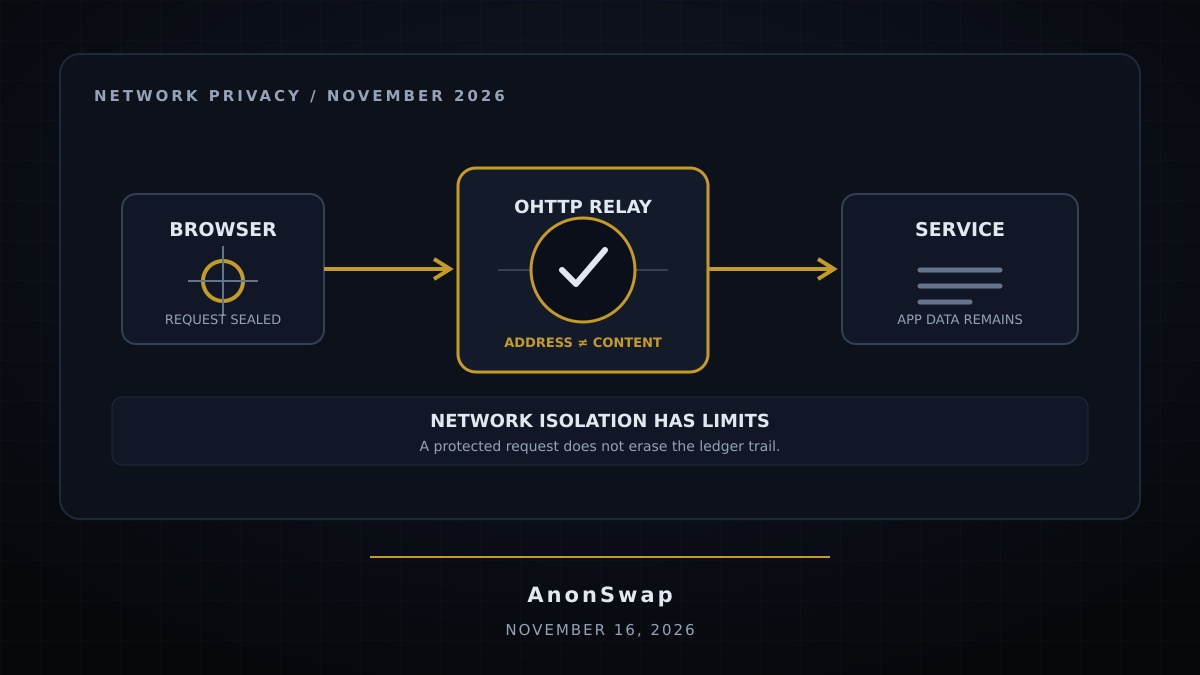
The detail most relevant to Network Isolation is how Mozilla says it protected telemetry collection. Its post explains that OHTTP routed encrypted requests through a relay: the relay could see a user’s IP address but not the request contents, while Mozilla received the contents without the user’s IP address. Mozilla also says individual telemetry records were deleted several months later and only aggregate results were retained and published. These are Mozilla’s reported practices, not a guarantee about all OHTTP deployments. (Mozilla, November 10, 2026; Mozilla Support, “Oblivious HTTP (OHTTP) explained,” checked November 16, 2026)
OHTTP is specified in IETF RFC 9458, which describes a client, relay, and gateway arrangement for encapsulated HTTP requests. Properly deployed, the separation is intended to make it harder for the origin to associate requests with a client, while limiting what the forwarding relay can learn about the request. The design still depends on distinct roles and implementation choices. It is not a magic tunnel, nor does the standard claim to remove every timing, operational, or application-level signal.
Conceptual diagram: OHTTP separates the network address from request contents across distinct roles; it does not hide application data from the destination.
Why the regulatory context matters
There is no single global privacy rule that turns network isolation into a universal crypto requirement. Instead, data-protection frameworks in major markets place different duties on organizations that handle personal information. A Mozilla product announcement does not change those rules, and the legal treatment of a particular crypto service depends on its activity, location, and users.
- United States: The Federal Trade Commission’s privacy-by-design guidance recommends incorporating privacy protections throughout product and service development. It is general consumer-protection guidance, not a crypto-specific network-isolation mandate. (FTC, “Privacy & Security by Design,” checked November 16, 2026)
- European Union: GDPR Article 25 calls for data protection by design and by default, including measures that take account of data minimization. A relay pattern may inform an engineering design, but the article does not establish that OHTTP alone satisfies GDPR duties. (Regulation (EU) 2016/679, adopted April 27 and published May 4, 2016)
- Canada: The Office of the Privacy Commissioner of Canada explains PIPEDA principles such as limiting collection, use, disclosure, and retention, alongside safeguards appropriate to the information’s sensitivity. (OPC Canada, “PIPEDA fair information principles,” checked November 16, 2026)
- Africa: South Africa’s Protection of Personal Information Act (POPIA) sets conditions for processing personal information by public and private bodies and addresses cross-border flows. It is one national framework, not a summary of every African jurisdiction. (South African Government, POPIA, Act 4 of 2013)
- Asia: Singapore’s Personal Data Protection Act governs the collection, use, and disclosure of personal data by organizations. As in other regions, network controls should be assessed against the applicable law and actual processing, not treated as a legal safe harbor. (Singapore Statutes Online, Personal Data Protection Act 2012, current version checked November 16, 2026)
For crypto users, financial surveillance is not only a question of whether an exchange asks for identity documents. Network operators, wallet and analytics providers, trading services, and public blockchains can each hold different pieces of a user’s activity. Laws may require some services to collect or retain information; technical privacy controls cannot cancel those obligations. For firms, a smaller and more carefully separated dataset can reduce exposure, but only if governance, retention, access, and vendor practices match the architecture.
The market-psychology trap: mistaking one boundary for privacy
When a privacy feature is announced, users can swing between fear and overconfidence. A worried user may assume that every online service is already correlating all activity. A reassured user may read “encrypted” or “isolated” as proof that no one can connect a session to a person. Both reactions flatten a layered system into a slogan.
That matters for global crypto markets, where changing rules, platform policies, and market stress can make people seek quick ways to move or protect assets. The Mozilla study does not report crypto-market behavior or price effects. The relevant behavioral lesson is narrower: perceived privacy can influence whether people share data, reuse accounts, or treat a public transaction as untraceable. Privacy tools should reduce specific risks without encouraging false confidence.
What network isolation protects—and what it leaves exposed
OHTTP’s design separates network identity from request contents across intermediaries. Browser fingerprinting defenses address another layer: the details a website can combine to distinguish a device. These controls can complement one another, but neither makes every data trail disappear. A site may still receive information a user types into it, and an application may create records tied to an account, order, or support request.
In crypto, a network connection is only one part of a transaction path. An IP address can be sensitive, but so can a wallet address, a timestamp, an asset pair, a service identifier, or the public history associated with an address. Linkage can arise from a user’s own disclosures or from records held by multiple providers. A non-custodial service can avoid holding a user’s assets while still relying on external routing or infrastructure; its custody model should not be confused with a guarantee about all metadata.
A practical inventory can begin with three separate layers:
- Connection: identify which network addresses, timestamps, and routing details are visible to relays or providers.
- Service: review what the swap or wallet provider records, which partners can access it, and how long it is retained.
- Ledger: treat addresses and transaction history as separate public data; a protected connection does not remove on-chain information.
Conceptual diagram: network controls, service data practices, identity requirements, and public-ledger visibility are distinct privacy layers.
How to make a more informed choice
Before using a wallet, exchange, or swap service, separate the protections it actually provides from the ones you hope it provides:
- Ask whether a privacy feature hides an IP address from a destination, limits tracking across websites, or changes what information a service collects. These are different outcomes.
- Check the service’s current terms, privacy notice, route partners, and applicable local rules. Do not rely on an old claim or assume that a non-custodial label means no third parties process data.
- Avoid linking public wallet activity to your name or routine accounts when you do not need to. Once information is recorded on a public ledger, a network relay cannot remove it.
- Treat privacy features as risk reduction, not invulnerability. A compromised device, a voluntarily shared identifier, or a provider’s lawful record can sit outside the feature’s boundary.
How non-custodial swaps fit
Non-custodial swaps can matter because users retain control of their assets rather than placing them in a platform custody account. That distinction can reduce certain custody and account risks. It does not automatically prevent a network provider from seeing a connection, a routing partner from processing transaction details, or a blockchain from publishing the transaction. Stablecoin policy and crypto regulation may also impose separate rules on issuers, platforms, or intermediaries depending on the jurisdiction.
AnonSwap’s published FAQ describes the service as non-custodial and says registration is not required. Those are service-level claims, not proof that every route or asset has identical data handling, or that a user’s activity is invisible. Review current terms and route details, consider the asset’s on-chain behavior, and follow applicable legal and tax obligations. (AnonSwap, FAQs, checked November 16, 2026)
The practical role of AnonSwap in the privacy ecosystem is therefore bounded: a non-custodial swap model is one design choice within a larger chain of wallets, networks, service providers, and public ledgers. Privacy Engineering is strongest when each layer states what it protects, minimizes unnecessary data, and avoids promising what it cannot deliver.
The Privacy Outlook for the Week Ahead
Mozilla’s November 10 publication puts two useful ideas in the same frame: make browser fingerprints less distinctive, and separate network identity from request contents where a protocol can support it. For users, the next step is not to assume that one new safeguard settles the privacy question. It is to ask which participant can see each piece of information, for how long, and under what rules.
For crypto services, the same discipline applies to connection logs, account and order records, partner access, and public-chain exposure. Network isolation can make correlation harder at one boundary. Clear data minimization, careful vendor governance, informed user choices, and realistic descriptions of non-custodial swaps are still necessary across the rest of the system.
Sources: Mozilla, “Open research, stronger privacy: Making Firefox users harder to fingerprint,” November 10, 2026; Mozilla Research, “Large-Scale Measurement and Real-World Mitigation of Web Browser Fingerprinting in the Wild,” accepted for CCS 2026; IETF, RFC 9458, “Oblivious HTTP,” January 2024; Mozilla Support, “Oblivious HTTP (OHTTP) explained,” updated March 5, 2026; U.S. Federal Trade Commission, “Privacy & Security by Design”; European Union, Regulation (EU) 2016/679, adopted April 27 and published May 4, 2016; Office of the Privacy Commissioner of Canada, “PIPEDA fair information principles”; South African Government, Protection of Personal Information Act 4 of 2013; Singapore Statutes Online, Personal Data Protection Act 2012; AnonSwap, FAQs. Checked November 16, 2026. This article is for informational purposes only and is not legal or financial advice.
Published November 16, 2026. Last updated November 16, 2026.
Frequently asked questions
What did Mozilla publish this week?
On November 10, 2026, Mozilla described research into browser fingerprinting and protections shipped in Firefox. It also explained that Oblivious HTTP (OHTTP) was used to separate a user's network address from the request contents in its data-collection safeguards.
Does OHTTP make a crypto transaction private?
No. OHTTP can limit which network participant sees a client's IP address and request contents together. It does not conceal public blockchain records, remove identity information submitted to a service, or guarantee anonymity.
How do network isolation and non-custodial swaps relate?
Network isolation can reduce exposure of connection information. Non-custodial swaps describe how assets are controlled; they do not by themselves hide network metadata, provider records, or on-chain activity.
Why does Privacy Engineering matter for global crypto markets?
Different jurisdictions regulate personal-data processing in different ways. Privacy Engineering helps users and services consider what information is collected, who can link it, how long it is retained, and what the law requires.