
Encryption Is Not a Privacy Plan: What Privacy Engineering Requires
• 8 min read • by Kelvin Jones
Encryption Is Not a Privacy Plan: What Privacy Engineering Requires
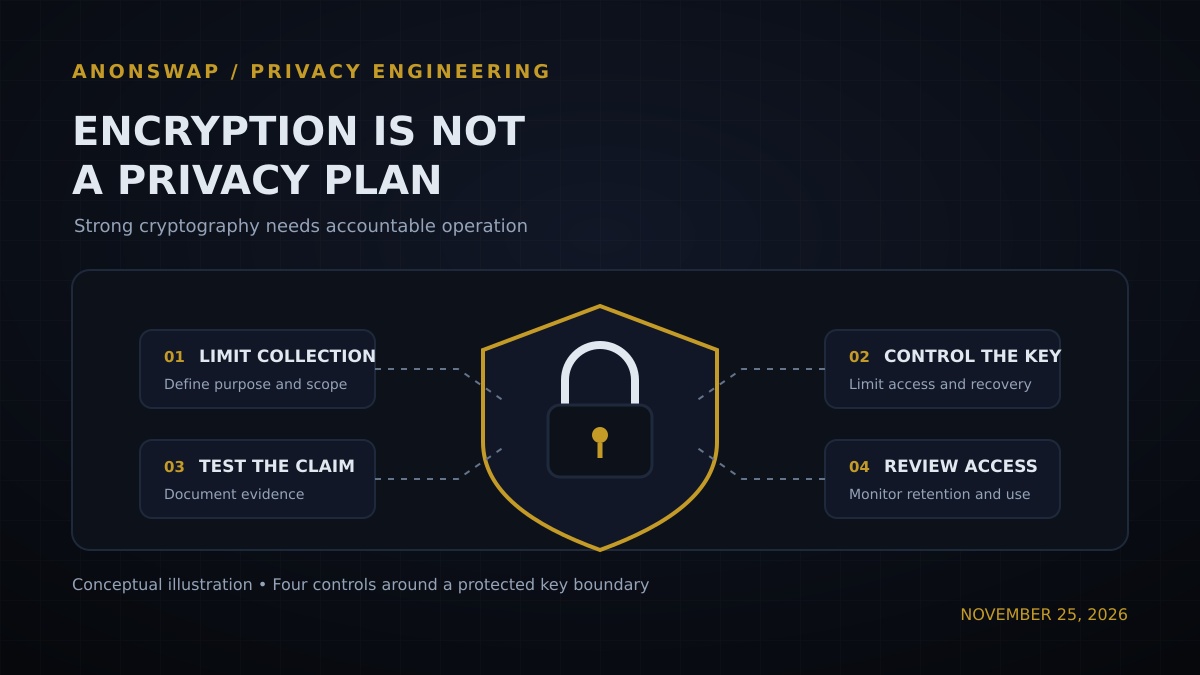
Encryption is essential, but it does not make every surrounding record private. A service can protect message contents while still processing connection details, account identifiers, or transaction metadata. In digital finance, a public ledger can preserve transaction relationships outside the encrypted channel altogether. The important privacy question is not simply whether encryption exists; it is what it protects, who controls the keys, and which records remain linkable.
On November 17, 2026, the Global Privacy Assembly (GPA) resolution addressed privacy-enhancing technologies (PETs) as instruments of privacy by design and data-protection accountability. It asks data-protection authorities to understand PETs' capabilities and limits, and urges organizations to pair deployment with governance, training, documentation, testing, monitoring, and audit. Monday's article on lattice-based zero-knowledge research examined a cryptographic proof construction. This article instead examines how encryption can fail users when the surrounding system lacks accountable design.
What the GPA resolution changes—and what it does not
The resolution came from the GPA's 48th annual meeting in Brussels, held November 16–19 (EDPS meeting page). The GPA is an international forum of data-protection and privacy authorities. The resolution is a policy statement, not a directly binding law for every company or jurisdiction; it creates no universal encryption mandate or product certification.
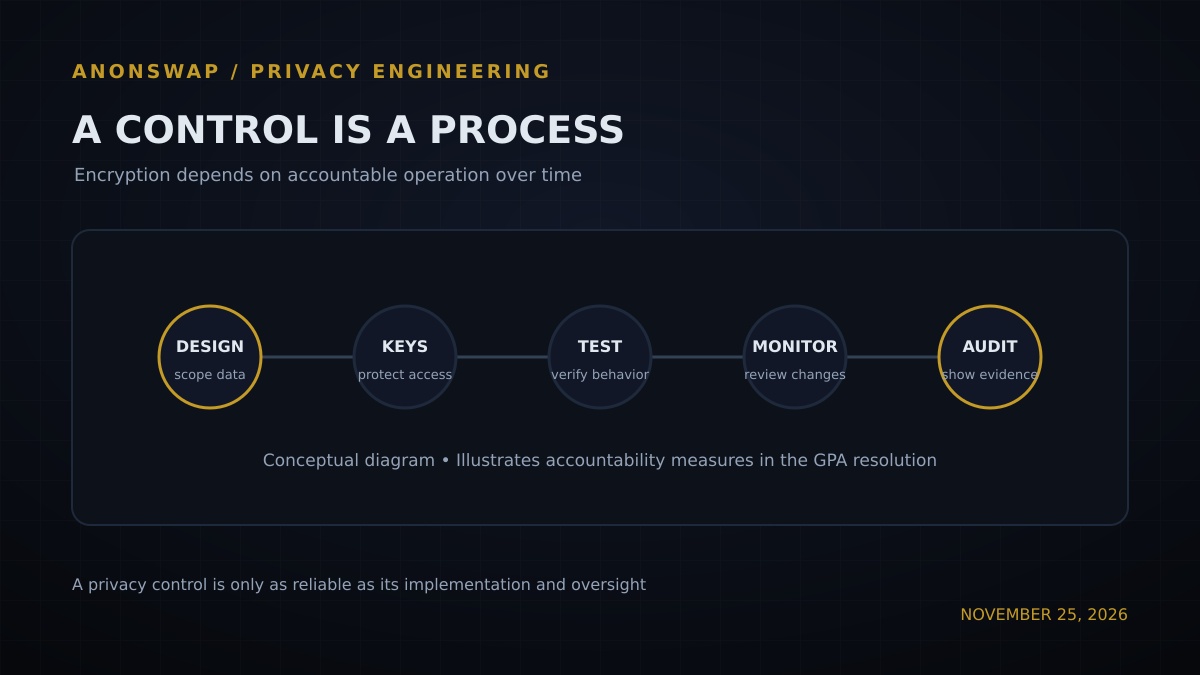
Its significance is the emphasis on the whole deployment. PETs can support data minimization and privacy by design, but usefulness depends on implementation and context. The resolution calls for understanding their limits and pairing deployment with accountability. Encryption illustrates the point: poor key custody, excessive access, or untested recovery can undermine protection.
Conceptual diagram: the operational checks named in the resolution. This is an illustrative view of accountability measures, not a GPA-prescribed implementation sequence.
Consider four questions when a service says it encrypts data:
- What is encrypted? Is the claim about a browser connection, stored records, backups, messages between users, or all of these?
- Who can decrypt it? A provider-controlled key, an account holder's device, or a separately managed key has different trust implications.
- What remains observable? Routing details, access times, account links, request identifiers, and public-ledger activity may sit outside the protected content.
- How is the claim maintained? Key rotation, access reviews, recovery, logging, testing, and deletion are operational responsibilities, not properties supplied by an algorithm alone.
The U.S. National Institute of Standards and Technology (NIST) describes key management as a lifecycle. Strong encryption can fail in practice if unauthorized systems access the key or plaintext, while metadata can reveal financial relationships even when contents remain encrypted.
The technical boundary: protected content versus exposed context
Encryption makes information unreadable without the appropriate key. HTTPS protects data in transit, but the service receives the request it processes. Stored-data encryption does not stop an authorized application from using decrypted contents. End-to-end encryption limits which service operators can read message contents, but does not automatically hide who communicated or when.
This boundary is also political. Organizations choose what to collect, how long to retain it, which vendors process it, and how they respond to legal demands. Encryption does not decide whether collection was necessary or whether access is accountable. Privacy engineering therefore includes minimization and governance as well as cryptography.
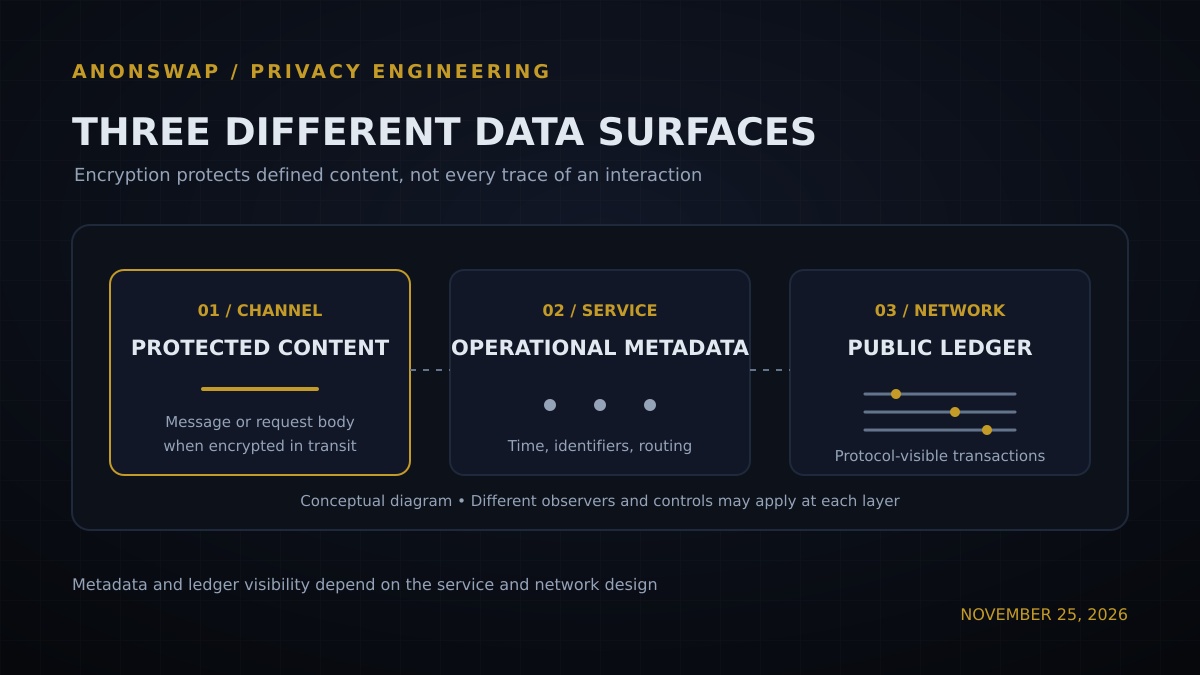
Conceptual diagram: encryption's coverage is narrower than the complete transaction path. The encrypted channel protects its contents; service metadata and public ledger data are separate surfaces.
Metadata leakage and blockchain analytics
Metadata describes an interaction rather than its protected content. It can include a connection address, time, account identifier, or service contacted. The actual fields vary; check the data path and provider disclosures.
Blockchain analytics adds a source of financial surveillance. Public networks expose transaction records according to their protocol, and analysis can identify patterns between addresses. Linking those patterns to a person requires other evidence and may be uncertain. Still, an address published beside a name or purchase creates an association that website encryption cannot remove.
- Network layer: connection addresses and timing may be visible to network participants or infrastructure.
- Service layer: an application may process account, request, or operational details to complete a task.
- Ledger layer: public transaction fields remain visible where the asset's protocol publishes them.
These are possible data surfaces, not evidence that a specific provider collected or combined them. A privacy review should ask whether identifiers can be joined across layers, who can do so, and whether access is limited and audited.
Global rules share concerns, but not one encryption rule
Privacy protections and encryption requirements depend on jurisdiction, organization, and processing context. These examples illustrate different legal and technical approaches; they are not a complete survey or legal advice.
| Region | Verified reference point | What it establishes—and does not |
|---|---|---|
| United States | NIST SP 800-57 Part 1 Rev. 5, published May 2020, provides cryptographic key-management guidance. | It is technical guidance, not a universal privacy statute for every crypto service. |
| European Union | GDPR Article 32 includes encryption among measures that may be appropriate to risk, alongside other security measures. | The obligation is contextual; encryption alone does not establish compliance. |
| Canada | The Office of the Privacy Commissioner says PIPEDA safeguards may include encryption, access limits, and organizational measures suited to sensitivity and risk. | PIPEDA's scope is not identical to every provincial or sectoral privacy regime. |
| Africa | The African Union Convention sets a regional framework that includes confidentiality and protection of personal data in network transmission. | The treaty's effect depends on state participation and domestic implementation; it is not one uniform rule for every African country. |
| Asia | Singapore's PDPA Protection Obligation requires reasonable security arrangements; the PDPC lists encryption as one possible measure. | This is Singapore-specific guidance, not a single rule for all Asian jurisdictions. |
These sources point to an engineering lesson, not uniform law: measures must fit the data and threat. The GPA's call for documentation, testing, monitoring, and audit matters because key handling, staff access, vendors, and retention can change over time.
Privacy erosion in digital finance
Digital finance creates records when a user opens a service, a provider processes a request, a partner participates, or a blockchain publishes settlement. Each stage has different access and retention rules. Encrypting one stage does not make the full flow private or hide public-chain records retroactively.
Privacy erosion can happen as useful records become linkable: an account identifier joins service visits, timing connects a request to a transaction, and a public address connects ledger activity to an identity. A lawful request, breach, or analytics process may combine fragments. This is a general risk model, not a claim about a specific case.
Privacy tools, including PETs, can reduce selected exposures: encryption limits access to contents, minimization reduces what exists, and access controls restrict retrieval. Each control has a threat model and must be tested. "Encrypted" does not explain who retains metadata; "private" is not a substitute for documentation.
How non-custodial swaps protect users—and their limits
Non-custodial swaps address asset control: users do not entrust an ongoing balance to a platform. This reduces one counterparty exposure, but is not encryption and does not erase blockchain records. Interfaces and routing partners still have technical and legal responsibilities.
Before using a service, distinguish custody from data collection. Check what information the service requests, what partners participate in the route, and what the relevant asset publishes. Routing partners, asset, transaction volume, and local law can affect what a swap requires. A "no account" or non-custodial design is not an anonymity guarantee, and privacy tools do not override applicable legal duties.
AnonSwap's privacy architecture
AnonSwap's published materials and repository posts describe its swaps as non-custodial and available without creating an account. These limited claims do not mean no information is processed or every route is identical. The repository does not establish that AnonSwap uses end-to-end encryption for all service data or a specific key-management system; this article makes no such claims.
Review current route information and terms before sending assets. Routing partners, asset, volume, and local law can affect requirements. A public blockchain may expose transaction data regardless of browser encryption. A sound privacy statement names its boundary, covered data, and limitations.
How Users Can Protect Themselves This Week
The GPA's resolution is a reminder to evaluate privacy features as systems, not slogans. For a wallet, exchange, or swap, practical checks include:
- Ask what the encryption claim covers. Look for clear distinctions between data in transit, stored data, backups, message contents, and metadata.
- Review key and access responsibilities. Prefer transparent explanations of who controls decryption, who can access records, and how access is reviewed.
- Minimize what you disclose. Avoid posting wallet addresses alongside personal identifiers, and do not provide information that is not needed for the task.
- Check the full transaction path. Review the asset, service, and routing-partner terms; recognize that public-ledger data remains governed by the network's design.
- Treat privacy tools as risk reduction, not guarantees. Encryption and non-custodial swaps address particular exposures; neither erases public records or overrides local requirements.
Encryption remains one of privacy engineering's essential tools. The GPA's November resolution underscores why it must be paired with proportionate design, testing, documentation, and accountability. For users, the practical question is not simply "Is it encrypted?" It is "What is protected, who can still see the surrounding data, and what evidence supports the claim?"
Sources: Global Privacy Assembly resolution, published November 17, 2026; EDPS meeting page, November 16–19, 2026; NIST SP 800-57 Part 1 Rev. 5, May 2020; GDPR Article 32; OPC Canada, PIPEDA Safeguards; African Union Convention, adopted June 27, 2014; Singapore PDPC, Protection Obligation. Informational only; not legal or financial advice.
Published November 25, 2026. Last updated November 25, 2026.
Frequently asked questions
What did the Global Privacy Assembly say about privacy-enhancing technologies?
Its November 2026 resolution calls for a shared understanding of PETs' capabilities and limitations, and urges proportionate governance, documentation, testing, monitoring, and audit alongside deployment.
Does encryption hide crypto transactions?
No. Encryption protects specified data in a defined context. It does not erase public blockchain records, hide every network or service metadata field, or guarantee that endpoints cannot access information.
Do non-custodial swaps guarantee privacy?
No. Non-custodial describes asset control. Routing partners, assets, volume, local law, and public blockchain visibility can affect what a swap requires or reveals.