
Proof Without Disclosure: The Privacy Stakes of Lattice ZK
• 8 min read • by Kelvin Jones
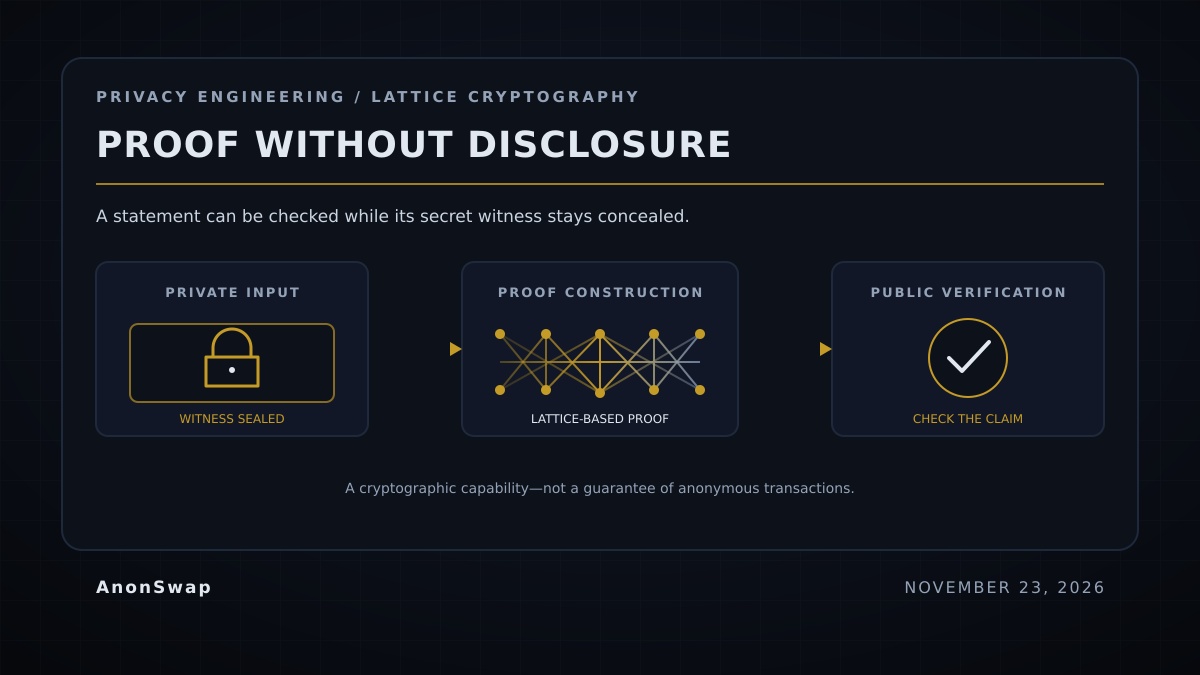
New cryptography can promise a smaller proof, a faster prover, or a more private statement. The difficult question is what those properties actually protect once a proof enters a real service, a public blockchain, and a regulated market. A research publication from IBM dated November 16 puts that question back in focus: it presents a concrete, implemented way to add zero-knowledge proofs to a lattice-based system. It is a meaningful engineering result, not evidence that a new privacy product or compliant transaction system is ready for use.
The distinction matters in a week when crypto regulation is already shaping what intermediaries must collect and pass along. A proof can reduce disclosure for a particular check. It cannot, on its own, erase surrounding records, settle how a rule applies, or make a wallet or swap private end to end.
What IBM Research published
IBM Research's November 16 paper, “A Toolkit for Succinct Lattice-Based Zero Knowledge Proofs”, describes a construction that integrates a linear-size zero-knowledge proof into LaBRADOR, a lattice-based proof system. The authors report an implementation in the LaZer library and benchmarks for several use cases. IBM's summary says the underlying lattice-based schemes can produce proofs under 100 KB for arbitrarily large statements; that figure describes the broader systems discussed in the paper, not a universal size guarantee for every proof or application.
The contribution is practical exploration of the costs and engineering challenges of combining succinctness with witness privacy. A “witness” is the secret information that supports a public statement. In principle, a verifier can check that a statement is true without receiving that secret. The U.S. National Institute of Standards and Technology (NIST) describes zero-knowledge proofs as a privacy-enhancing cryptographic technique for proving a mathematical statement without revealing information used to establish it.
That is a technical capability, not a blanket privacy outcome. The paper does not claim that a crypto exchange, stablecoin, wallet, or blockchain has deployed this construction. Nor does a new implementation establish that it has been independently audited, standardized, or adopted by regulators. As with other cryptographic systems, real-world assurance depends on the statement being proved, implementation details, parameters, the verifier, and how the surrounding product handles data.
Why proof engineering intersects with regulation
Crypto rules often focus on services and information flows rather than on cryptography in isolation. Different jurisdictions impose obligations on particular regulated businesses; they do not all impose the same duties on every protocol or individual user.
- In the United States, FinCEN's May 9, 2019 guidance on convertible virtual currency applies existing money-services-business rules to particular business models. It is a functional analysis, not a ruling that every software developer or self-custody user is a money transmitter.
- In the European Union, Regulation (EU) 2023/1113, published June 9, 2023 and applicable from December 30, 2024, requires covered crypto-asset service providers to transmit specified originator and beneficiary information with transfers.
- Canada's FINTRAC says its travel-rule guidance for virtual-currency transfers took effect June 1, 2021. It applies to listed reporting entities and requires certain information to accompany transfers they send or receive.
- In Africa, South Africa provides one jurisdictional example: the FSCA's October 20, 2022 declaration brought crypto-asset financial services within the scope of its financial-product framework. It should not be read as a single rule for the entire continent.
- In Asia, Singapore's Monetary Authority describes licensing requirements for digital-payment-token services, including an independent auditor's assessment for new applicants' proposed AML/CFT and consumer-protection processes. This is a Singapore example, not a description of every Asian market.
These approaches create a practical design problem. A provider may need to verify or transmit specified information, while a user has a legitimate interest in minimizing the personal data exposed to counterparties, analytics vendors, or public infrastructure. Stablecoin policy and other transfer rules also vary by jurisdiction. Whether a cryptographic proof can help depends on the exact obligation: proving that a condition is met is not automatically equivalent to supplying every item of information a rule requires.
The promise—and boundary—of a proof
| Stage | What may be shown | What remains outside the proof |
|---|---|---|
| A private witness supports a defined statement | A verifier checks the statement under a specified protocol | The witness is not automatically hidden from the system that generated or stored it |
| A proof is delivered to a verifier | The verifier receives evidence for that particular claim | Network metadata, account records, and transaction timing may still identify or link activity |
| A service acts on the result | The service may use the result in a workflow | Applicable reporting, recordkeeping, and disclosure requirements still depend on law and role |
Conceptual diagram: the proof's scope is narrower than the complete data path.
The separation can be useful. A service might use a proof to check a narrowly defined property without collecting the underlying document itself. But the system must first define the property, establish who generated the proof, handle rejected and disputed cases, and decide whether the evidence is adequate for the relevant rule. If the proof is tied to an account, device, or reusable identifier, repeated checks may become linkable even when the underlying witness is not shown.
There is also a trust boundary. Users must know which party creates the proof, which party verifies it, whether the verifier learns anything beyond the intended result, and whether a database keeps the original witness. A privacy-enhancing primitive cannot correct excessive collection elsewhere in the workflow. Nor does a proof make public blockchain transfers confidential if addresses, amounts, or timing remain visible on-chain.
Global crypto markets and the psychology of privacy
Markets can react to a cryptography paper as if technical progress immediately changes product risk. That is an easy narrative to follow and a poor substitute for deployment evidence. A benchmark is not a security audit; a library feature is not a production integration; and a zero-knowledge proof is not synonymous with anonymity.
The opposite overreaction is also possible. When users hear that a provider must collect or transmit information, they may assume that every transaction is equally exposed or that privacy tools have no role. Financial surveillance is not a single switch: rules differ by jurisdiction and business activity, and data exposure depends on the service architecture. The right response is to separate known obligations from assumptions about how a specific provider implements them.
For users, uncertainty can produce herd behavior: moving funds toward a newly promoted privacy feature without checking what it proves, or abandoning a useful tool because a headline makes surveillance sound universal. A calmer checklist is more useful:
- Confirm whether the cited work is a paper, a prototype, an audited release, or a deployed service.
- Identify the verifier and the exact claim being proved; do not treat “zero knowledge” as proof that no data is collected.
- Ask whether a transaction leaves public ledger, network, account, or partner records outside the proof.
- Check the current terms and legal requirements for the actual service and jurisdiction before sending funds.
These are operational questions, not a forecast for token prices or a claim that privacy engineering will immediately change global crypto markets. The market implication is narrower: credible proof systems can expand design options, while the cost of overstating privacy remains high for users and providers.
How non-custodial swaps protect users—and what they do not
Non-custodial swaps can reduce one distinct risk: placing assets in a long-lived exchange account or giving a service continuing control of a wallet. They do not automatically conceal the transaction. A swap can still involve public addresses, visible timing and amounts, network requests, service records, or third-party liquidity providers.
AnonSwap's role in the privacy ecosystem
That distinction is central to AnonSwap's role in the privacy ecosystem. AnonSwap describes its product as a non-custodial swap service that does not require an account or a connected wallet; its FAQ describes a flow in which a user specifies an asset, a payout address, and sends to a one-time deposit address. Those are product-design claims, not a guarantee of anonymity, regulatory treatment, or the absence of records at every routing partner.
Users should therefore evaluate custody and data disclosure separately. Before starting a swap, review the supported route, deposit instructions, payout address, current terms, and applicable law. Do not send funds on the assumption that a non-custodial label or zero-knowledge technology can undo an address disclosure, hide a public transaction, reverse a mistake, or override a provider's legal duties. Privacy tools work best as layers with clear limits, not as promises of invisibility.
The Privacy Outlook for the Week Ahead
The IBM publication is a useful signal of continued work on practical zero-knowledge proofs over lattice assumptions. Its importance is that researchers are measuring implementation costs and confronting the challenge of adding witness privacy to succinct proof systems. What it does not show is a production-ready solution for crypto compliance or a new form of anonymous swapping.
A credible deployment signal would include:
- Publicly reviewable code and a clear threat model.
- Independent security analysis of the implementation and its parameters.
- Evidence that an actual service uses the proof and documentation of what it still records.
The next step for readers is to watch for independently reviewable code, security analysis, precise statements about what is hidden, and evidence of real integrations. Regulators and service providers will continue to define obligations through jurisdiction-specific rules; engineers will continue to explore ways to prove selected facts with less disclosure. The two tracks can inform each other, but neither cancels the other.
For everyday users, the durable lesson is simple: ask what the proof reveals, what it omits, and what the surrounding service still records. Non-custodial swaps and other privacy tools can limit particular exposures, but they are not substitutes for checking a route, understanding a public ledger, or following local requirements.
Sources: IBM Research, “A Toolkit for Succinct Lattice-Based Zero Knowledge Proofs,” November 16, 2026; NIST, “Zero-Knowledge Proof (ZKP)”, continuously updated; FinCEN, “Application of FinCEN’s Regulations to Certain Business Models Involving Convertible Virtual Currencies,” May 9, 2019; European Union, Regulation (EU) 2023/1113, published June 9, 2023; FINTRAC, “Travel rule for electronic funds and virtual currency transfers,” published May 2021, effective June 1, 2021; South African FSCA, “Declaration of Crypto Assets as a Financial Product,” October 20, 2022; Monetary Authority of Singapore, “How to Apply,” updated August 20, 2026; AnonSwap, product FAQ. Sources checked November 23, 2026. This article is for informational purposes only and is not legal or financial advice.
Published November 23, 2026. Last updated November 23, 2026.
Frequently asked questions
What is new about IBM's lattice-based zero-knowledge toolkit?
IBM Research described a concrete construction and implementation that adds zero-knowledge proofs to the LaBRADOR lattice-based proof system, and reported benchmarks for selected use cases. It is research, not a deployed crypto service.
Can a zero-knowledge proof make a crypto transaction anonymous?
Not by itself. A proof can establish a defined statement without exposing its witness, but transaction metadata, public ledger records, network data, and service records may remain visible.
Do zero-knowledge proofs replace crypto compliance requirements?
No. Applicable requirements depend on the service, transaction, and jurisdiction. A proof can support a narrowly defined verification task, but it does not automatically replace required originator, beneficiary, or recordkeeping information.