
How to Build a Crypto Privacy and Compliance Readiness Checklist
• 8 min read • by Kelvin Jones
How to Build a Crypto Privacy and Compliance Readiness Checklist
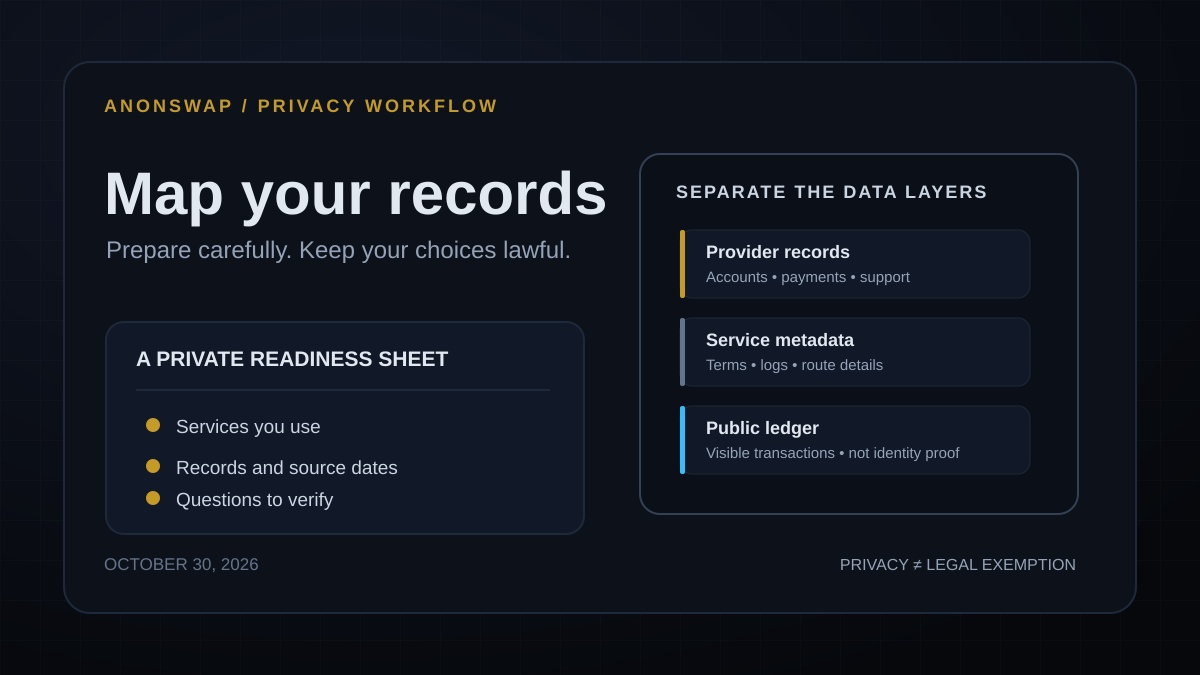
A regulatory headline can make people feel they need to act immediately. A safer first move is to understand which services they use, what records those services may hold, and which questions remain unanswered. This guide turns that into a private, lawful preparation exercise—not a way to avoid an investigation, sanctions, taxes, or other obligations.
On October 21, 2026, FinCEN said it had issued its first administrative subpoena under a specific Bank Secrecy Act authority in an investigation involving a Greek bank. The release did not identify the bank or describe the records requested. Monday’s overview of the cross-border action covers the policy context; Wednesday’s explanation of the correspondent-account mechanism covers how the authority works. This Friday workflow is different: it helps you organize your own provider and record map without making assumptions about that investigation.
What You Need
- A few minutes and a private place to make notes.
- A list of crypto-related services you currently use, such as a bank, exchange, wallet provider, or swap service.
- Access to each provider’s official terms and privacy notice.
- A secure storage location you already trust. Never write down a seed phrase, private key, wallet password, or recovery code.
No particular app, operating system, or software version is required. This is a document-based workflow; it does not ask you to upload personal records or screen other people.
Why Prepare Before a Regulatory Inquiry?
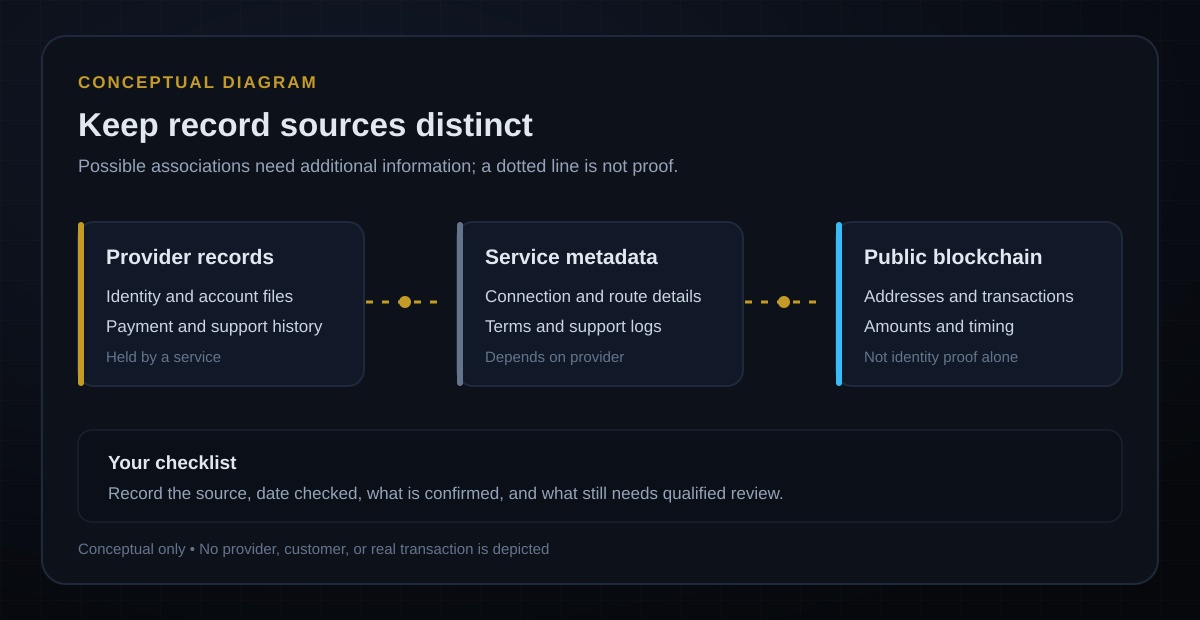
Financial information can be held by different parties: a bank may keep payment records, a crypto service may keep account or support records, and a public blockchain may expose transaction details. Those sources are not interchangeable, and an address appearing on a public ledger does not by itself establish who controls it. The Wednesday article explains why connecting separate records requires additional information.
The October 21 FinCEN announcement is a specific agency statement about one bank inquiry, not evidence that every crypto user or wallet is under investigation. Its value here is as a reminder to distinguish what is known from what is inferred. OFAC’s published compliance framework is written for organizations and identifies a risk-based approach; it is not a personal legal checklist. The simple inventory below is an organizational aid, not a substitute for advice from a qualified professional.
Privacy tools also address different layers. Tor Browser and onion services can change how a connection reaches a website, as described in the Tor Project’s documentation. They do not remove a provider’s existing records, change public blockchain history, or make an activity exempt from law. Crypto privacy begins with knowing which party sees which part of a transaction.
The Five-Step Readiness Workflow
-
List the services you actually use. Start with services connected to your crypto activity: a bank or payment provider, a custodial exchange, a self-hosted wallet, a swap interface, and any route or partner named in the service’s terms. Include only services you recognize and use. Do not copy wallet secrets, full account numbers, identity documents, or other sensitive material into the checklist. A service name and the date you last reviewed it are enough to begin.
-
Separate custody, identity, and transaction records. For each service, note whether it holds assets for you, whether you created an account, and what types of records its current official materials say it may collect or retain. Treat these as different questions. A non-custodial interface may not hold your balance, but a transaction can still be visible on a public blockchain and a provider or routing partner may process information. If the policy is unclear, record “not confirmed” rather than guessing.
-
Check the primary source and capture the date. Navigate to the provider’s official website yourself; avoid links in unsolicited messages or search advertisements. Read the current terms, privacy notice, and support guidance relevant to your location and the service you use. Write down the page title, official URL, date checked, and one short factual note. Do not treat a marketing phrase, a third-party summary, or an old article as proof of current requirements. If a legal rule may apply to you, mark it as a question for qualified counsel instead of interpreting it on your own.
-
Keep a lawful record packet without creating a secret archive. Preserve ordinary receipts, transaction confirmations, and tax or account documents you are already entitled or required to keep. Store them in a protected location, limit access, and follow the provider’s instructions for obtaining your own records. Keep only what you need; a privacy inventory should point to records, not duplicate identity documents or expose credentials. Never delete or alter records to obstruct a request. If you receive legal process or a sanctions-related notice, use verified official contact details and seek qualified legal advice about your obligations.
-
Write a pause-and-review plan. Note which provider page you will recheck, what information you still need, and how you will verify a request before responding. If a message asks for a seed phrase, private key, password, remote access, or an urgent transfer, stop and contact the provider through a channel you find independently. Revisit the checklist when a provider, asset, route, or relevant rule changes. It is a prompt for careful review, not a trigger to move funds.
Common Mistakes and Privacy Leaks
- Treating a news story as a new rule for everyone. Read the agency’s actual release and separate the stated facts from commentary. The October 21 FinCEN notice does not say it targeted a crypto company or individual wallet.
- Mixing different records together. Provider-held identity information, service logs, and public-chain transactions have different sources and limits. A possible link is not proof of identity or intent.
- Keeping too much in one note. A checklist should not become a copy of your passport, account credentials, full wallet history, or recovery material. Use references and dates where possible.
- Assuming privacy tools remove other records. Tor Browser or onion services may affect network-level exposure, but they do not erase records already held by a financial provider or alter a public ledger.
- Treating non-custodial swaps as a legal or privacy shield. Non-custodial swaps do not guarantee anonymity or exemption from local requirements. Ask what is unclear and do not infer requirements from another provider or asset.
How AnonSwap Fits Into the Workflow
AnonSwap’s published materials describe its service as non-custodial and say users can transact without creating an account. Those statements can help you record the custody and account questions for one possible service; they are not a guarantee that every route has the same data practices, requirements, or outcome.
If you consider using AnonSwap, check the current route information and terms before acting. Routing partners, asset, transaction volume, network conditions, and local law can affect what a swap supports or requires. A public blockchain may still expose transaction details. Review the complete flow rather than treating a label such as “non-custodial” as an anonymity promise.
The same principle applies to privacy tools: Tor Browser and onion services may protect aspects of the connection to a website, but they do not replace accurate records or legal advice. Use services lawfully, follow the laws and tax rules where you live, and never share wallet secrets with anyone claiming to help.
Your Privacy Checklist for This Week
- List the crypto-related services you use without recording wallet secrets or identity documents.
- Note separately what each service says about custody, accounts, and records.
- Save the official source URL and date checked for each open question.
- Keep only necessary lawful records in a protected location and do not alter or destroy them to obstruct a request.
- Verify unexpected requests independently and consult qualified counsel when legal duties are unclear.
Sources: FinCEN, “Operation Economic Outcast Targets Iran’s Shadow Fleet Networks”, October 21, 2026; OFAC, “A Framework for OFAC Compliance Commitments”, published May 2, 2019; Tor Project, “Tor Browser”, “Downloading”, “Updating”, and “Onion Services”. Checked October 30, 2026. This is a document-based workflow and requires no particular software or software version; online documentation may change. The article is informational only, not legal or financial advice. Follow the laws and tax rules where you live.
Published October 30, 2026. Last updated October 30, 2026.
Frequently asked questions
What is a crypto privacy readiness checklist?
It is a private inventory of the services you use, the records they may hold, the official terms you checked, and questions to resolve before an urgent decision. It is not a legal compliance determination.
Does using Tor Browser hide financial records?
Tor Browser and onion services can affect how a web connection is routed, but they do not erase records held by a provider or public blockchain data. They do not change legal duties.
Do non-custodial swaps guarantee privacy?
No. Non-custodial describes a custody model, not anonymity. Routing partners, assets, transaction size, network, and local law may affect what a swap requires or reveals.
How does AnonSwap fit into a preparedness plan?
AnonSwap's published materials describe a non-custodial service that does not require an account. Check current route details and terms; this does not guarantee anonymity or remove legal obligations.