
The Correspondent-Account Lever Behind Financial Surveillance
• 8 min read • by Kelvin Jones
The Correspondent-Account Lever Behind Financial Surveillance
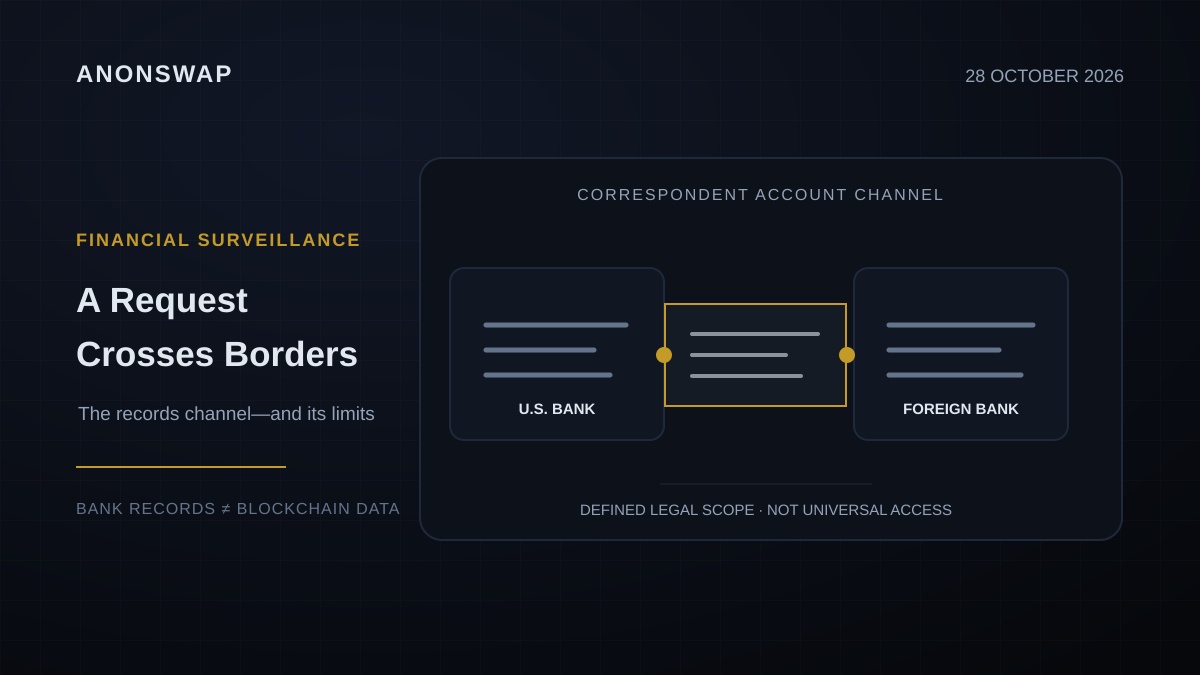
A financial record does not stop at a border just because the institution it concerns is abroad. On October 21, 2026, the U.S. Financial Crimes Enforcement Network (FinCEN) said it had issued its first administrative subpoena under a Bank Secrecy Act authority that reaches certain records held by foreign banks.
The announcement named an investigation into a Greek bank’s potential ties to Iran and its proxies. It did not name the bank, describe the records requested, allege that cryptocurrency was involved, or announce a new crypto rule. The privacy question is therefore not whether every wallet is suddenly visible to U.S. authorities. It is how a banking relationship can become a legal channel for records across borders—and why that channel is separate from public blockchains.
This is the technical and political angle behind Monday’s overview of the October 21 cross-border crackdown. Here, the focus is the mechanism, what it reaches, and what users can reasonably do to limit unnecessary exposure.
What changed on October 21
FinCEN’s October 21 release said the agency was coordinating with European partners and had used 31 U.S.C. § 5318(k) to issue an administrative subpoena in an investigation concerning a Greek bank. It also said it had sent requests for information about banks’ relationships with designated Iranian financial institutions. Treasury’s accompanying announcement described sanctions against specified law firms and shipping agents, but did not connect those entities to crypto transactions (FinCEN, October 21, 2026; U.S. Treasury, October 21, 2026).
“First” here refers to FinCEN’s first issuance of an administrative subpoena under this particular authority, as the agency described it. It does not mean the first subpoena ever served on a foreign financial institution, nor does the release disclose the subpoena’s contents. Those details matter: an investigation announcement is not a judgment, and the public record does not support guesses about which records were demanded.
How the foreign-bank record mechanism works
Section 5318(k) and its implementing regulation, 31 C.F.R. § 1010.670, concern a foreign bank with a U.S. correspondent account. Under specified conditions, the Treasury Secretary or Attorney General may seek records related to that account, including certain records held abroad. This is not a general power to retrieve anyone’s financial history anywhere (31 C.F.R. § 1010.670).
The correspondent account is the connection point: a foreign bank’s relationship with a U.S. bank can provide a route to seek records connected to that account, including records held abroad. It is a specific statutory mechanism, not evidence that every overseas institution or customer is within reach.
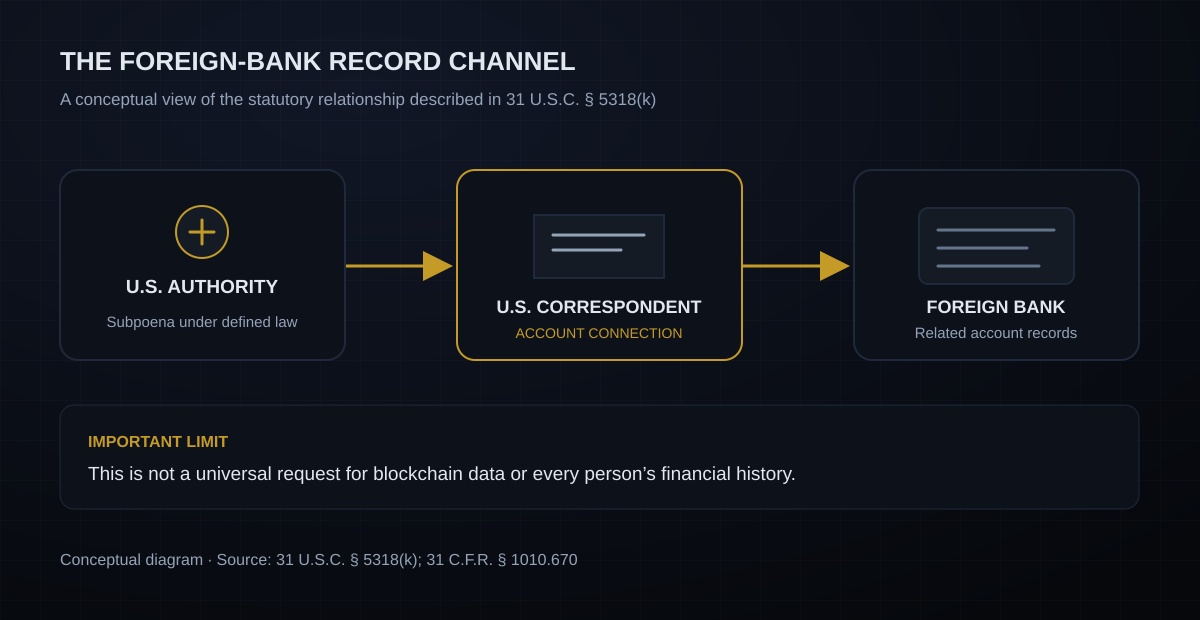
The mechanism can be understood in three steps:
- A foreign bank has a correspondent account in the United States.
- An authorized U.S. official issues a subpoena or summons under the law’s conditions for records related to that account.
- If the foreign bank does not comply or contest the request as provided by law, the regulation sets out consequences for the U.S. correspondent relationship.
This structure combines legal authority with financial-network leverage. The trigger is the defined correspondent relationship and account-related records. The public release does not establish that any crypto firm, wallet, or user was the subject of this investigation.
What a bank subpoena can—and cannot—show about crypto
A bank subpoena seeks information from a covered financial institution. A public blockchain can expose transaction details—such as addresses, amounts, and timing—without a subpoena, but those details do not automatically identify an address owner.
Metadata leakage occurs when separate records make one another more revealing. A bank may hold customer and payment records, a service may hold account or connection logs, and a blockchain may publish transactions. A reliable identity-to-address link can make public activity easier to interpret. The announcement does not say these data sets were joined in the Greek bank inquiry.
Blockchain analytics adds another layer. Transaction patterns can group some Bitcoin addresses, but groupings are inferences, not proof that every address belongs to one person. Shared services and changing wallet practices complicate interpretation. A foundational study by Sarah Meiklejohn and colleagues examined Bitcoin’s public graph; its findings are not a universal rule for every chain (Meiklejohn et al., ACM IMC, 2013).
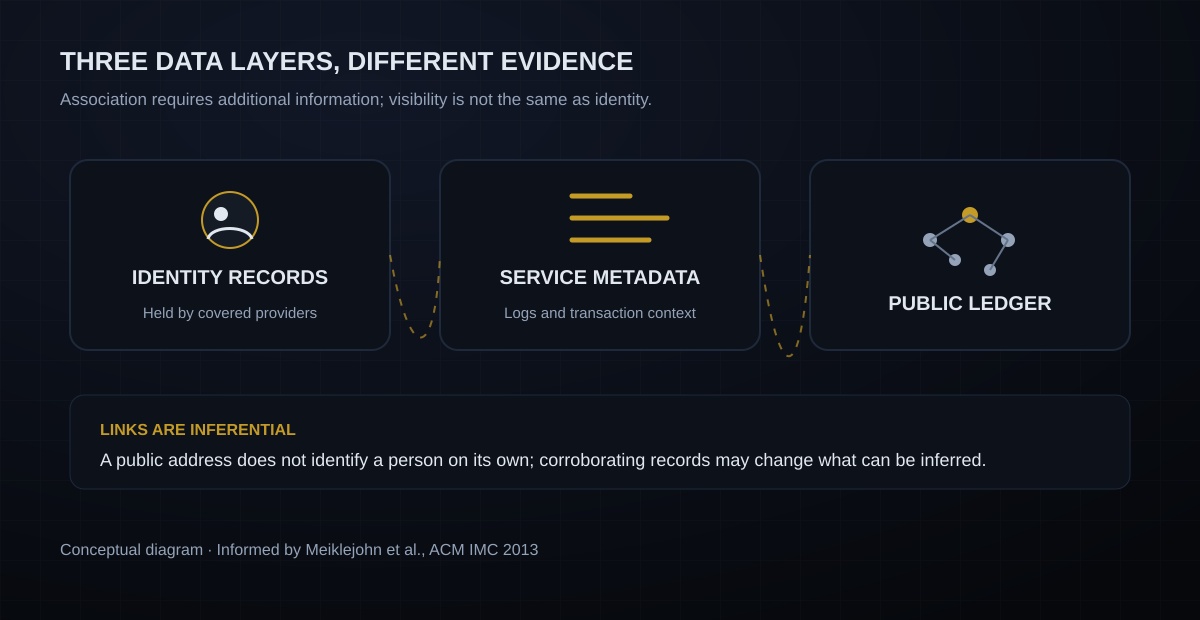
The practical distinction is important:
- A bank subpoena does not itself decrypt a wallet or reveal a private key.
- Public-chain visibility does not itself prove a wallet’s owner or intent.
- Linking identity data to on-chain activity requires additional information and careful interpretation.
These channels can interact, but each has a different source, legal basis, and evidentiary limit.
Financial surveillance has different rules across regions
The October announcement is U.S. action, not a global standard. Other jurisdictions have their own rules governing covered firms and transfers. These examples show why users should check the entity and location involved rather than assuming one cross-border rule applies everywhere.
| Region | Relevant framework | Privacy context |
|---|---|---|
| United States | 31 U.S.C. § 5318(k) and 31 C.F.R. § 1010.670 | A defined foreign-bank correspondent-account mechanism; the October 21 release described one investigation. |
| European Union | Regulation (EU) 2023/1113, applicable from December 30, 2024 | Sets information requirements for covered transfers of funds and certain crypto-assets involving regulated providers. |
| Canada | FINTRAC guidance on the travel rule for electronic-funds and virtual-currency transfers | Requirements apply to covered reporting entities and transactions under Canadian law. |
| Africa | FATF virtual-asset guidance, implemented through national systems | FATF guidance is an international standard, not a single Africa-wide statute; national rules differ. |
| Asia | Singapore’s Payment Services Act includes digital-payment-token services | This is one national framework, not a uniform regional rulebook. |
Sources: EUR-Lex, Regulation (EU) 2023/1113; FINTRAC, Travel rule for electronic funds and virtual currency transfers; FATF, Updated Guidance for a Risk-Based Approach to Virtual Assets and VASPs, October 28, 2021; Monetary Authority of Singapore, Payment Services Act 2019.
Privacy erosion in digital finance
Digital finance creates records during onboarding, transfers, service requests, compliance reviews, and public-chain settlement. Providers collect and retain different data. Exposure depends on the service, counterparties, asset, transaction size, applicable law, and what is public on-chain.
Many small records can disclose habits, counterparties, or financial relationships when combined. Providers may review activity during a regulatory crackdown, but the October 21 notice does not establish that a specific crypto service did so. Financial surveillance through regulated institutions and analytics of public data are separate processes.
Privacy tools are most useful when they reduce a specific exposure. Avoiding unnecessary accounts can reduce what a service asks you to provide. Fresh addresses may reduce casual linkage on some networks, but do not erase prior transactions or guarantee separation. Secure devices and reject unsolicited identity requests.
How non-custodial swaps protect users—and their limits
Non-custodial swaps can reduce dependence on a service that holds a customer balance: the user retains control of assets instead of depositing them in a platform account. This may reduce the need for account-level identity data at the interface, but custody, identity disclosure, and transaction visibility are separate.
Before using a swap service, check who provides the route, what information each party requests, and what happens if a transaction is delayed or rejected. Partners, supported assets, transaction amount, and local rules can change the experience. Public-chain activity may remain observable, and a provider may apply compliance controls. Non-custodial design neither avoids legal obligations nor makes an address anonymous.
AnonSwap’s published service materials describe its swaps as non-custodial and say users can transact without creating an account. Those are limited product claims about the interface and custody model—not a promise that no routing partner processes data or that every swap has identical requirements. A realistic privacy assessment should include the complete route and the network used, not just the front-end label.
How Users Can Protect Themselves This Week
The October 21 notice is a reason to understand data flows, not to panic or move assets impulsively:
- Read the underlying agency release before treating an enforcement headline as a new rule for all crypto users.
- Check which company or partner handles a swap, what data its current terms say it collects, and whether it takes custody.
- Avoid sending identity documents or wallet details in response to unsolicited messages; confirm requests through the service’s official channels.
- Keep records that explain legitimate transactions, and consult qualified counsel if a sanctions restriction or legal demand may apply to you.
- Remember that a public transaction can remain visible even when no custodial account is involved; do not treat privacy tools as anonymity guarantees.
This week’s mechanism is specific to a foreign-bank subpoena in a particular investigation. It does not establish a general crypto surveillance power or a finding about ordinary wallet users. Understanding how institutional records, service metadata, and public ledgers meet is more durable than relying on a slogan.
Sources: FinCEN and U.S. Treasury, October 21, 2026; 31 C.F.R. § 1010.670; Regulation (EU) 2023/1113; FINTRAC travel-rule guidance; FATF, October 28, 2021; Meiklejohn et al., 2013. This article is for informational purposes only and is not legal or financial advice.
Published October 28, 2026. Last updated October 28, 2026.
Frequently asked questions
What did FinCEN announce on October 21, 2026?
FinCEN said it had issued its first administrative subpoena under 31 U.S.C. § 5318(k) as part of an investigation into a Greek bank's potential ties to Iran and its proxies. The public release did not identify the bank or describe the records requested.
Does the subpoena mean that U.S. authorities can access any crypto wallet?
No. The cited authority concerns records of a foreign bank with a U.S. correspondent account. The October 21 release did not say that the subpoena targeted a crypto company, a blockchain, or an individual wallet.
How do financial surveillance and blockchain analytics differ?
A bank subpoena seeks records from a covered financial institution. Blockchain analytics examines public transaction data and may infer links between addresses. The sources and limits of those records are different.
Do non-custodial swaps guarantee privacy?
No. A non-custodial design concerns control of assets, not guaranteed anonymity. Routing partners, assets, transaction size, local law, and public blockchain data can affect what information is collected or visible.