
Whale Wallets and Bitcoin Puts December 2025: Structural Volatility and Trade-Level Playbook
• 9 min read • by Kelvin Jones
Whale Wallets and Bitcoin Puts December 2025: Structural Volatility and Trade-Level Playbook
🧠 Executive Summary
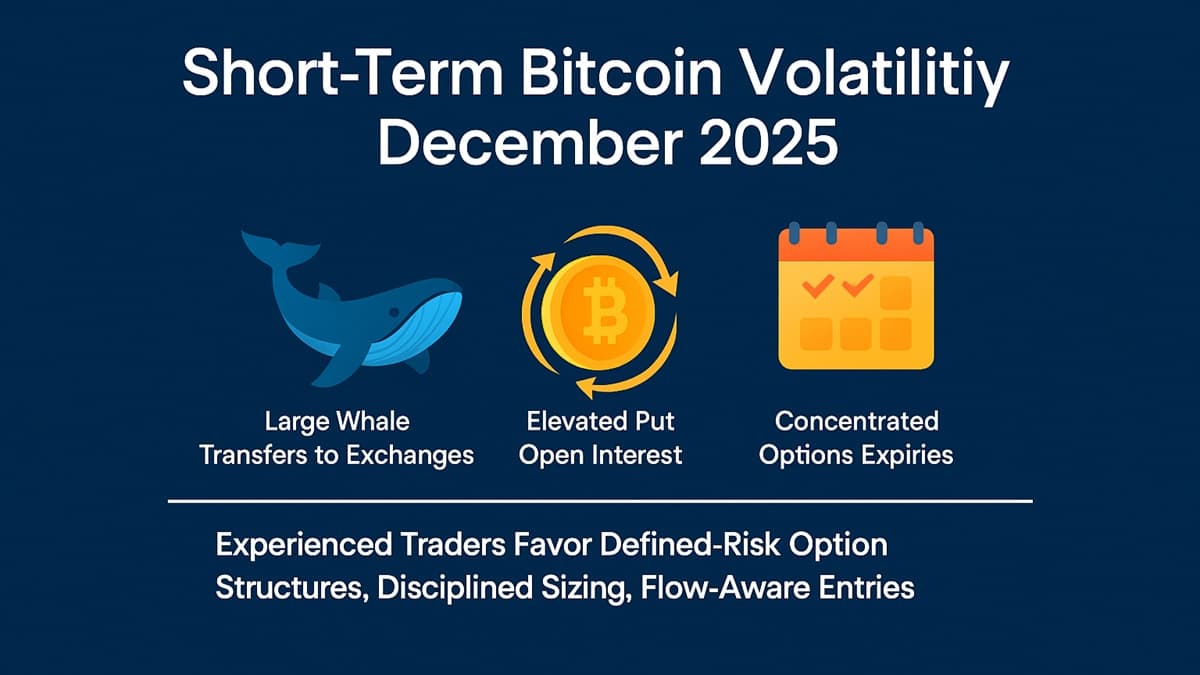
December 2025 has produced a concentrated set of structural drivers that are materially increasing short-term Bitcoin volatility. Large whale transfers to exchanges, elevated put open interest, and concentrated options expiries are interacting with thin year-end liquidity to create asymmetric risk around key strikes. For experienced traders this environment favors defined-risk option structures, disciplined sizing, and flow-aware entries rather than outright directional bets. This piece explains the mechanics, highlights the most actionable signals, and provides a practical checklist for trade execution.
Market Context and Why This Matters
The market is no longer driven solely by spot accumulation or retail momentum. Institutional desks and large holders are using derivatives to express and hedge views, and those flows now exert persistent pressure on spot price. Two dynamics matter most:
- Whale Distribution — Large addresses moving BTC to exchanges increases available sell liquidity and raises the probability of forced selling if leveraged positions unwind. These flows are a leading indicator of near-term price pressure when sustained.
- Options Flow and Concentrated Expiries — Elevated put open interest and clustered expiries create gamma and hedging flows that can push price toward “max pain” strikes. When many options expire at the same strike, market makers hedge dynamically, amplifying moves as delta changes.
Together these forces mean that narrative-driven rallies can be capped by options supply, while downside moves can be exaggerated by concentrated hedging and thin liquidity.
Options and Structural Supply Dynamics
Options desks and large holders are shaping the tape in three specific ways:
- Persistent Call Selling — Selling calls into rallies creates a supply wall that can cap upside until those positions are neutralized or rolled. This is particularly relevant when implied volatility compresses and desks harvest premium.
- Rising Put Demand — A surge in put buying increases hedging flows and raises the put/call ratio. High put open interest around specific strikes concentrates gamma exposure and makes those strikes focal points for price action.
- Expiry Clustering — When large notional expiries cluster, market makers must hedge dynamically. That hedging can create directional pressure toward the strike with the largest net exposure, especially in low-liquidity windows.
Understanding these mechanics explains why price can move violently without a new macro headline: the plumbing of the options market is doing the work.
What Traders Should Watch Next
Flow and Positioning
- Exchange inflows from whale addresses — sustained inflows are a red flag for near-term selling pressure.
- Whale address behavior — accumulation on cold wallets versus exchange transfers tells a different story about intent.
Options Metrics
- Put/Call Ratio — a rising ratio signals growing downside hedging.
- Implied Volatility Skew — negative skew and elevated IV at lower strikes indicate demand for downside protection.
- Concentrated Open Interest — identify the strikes with the largest notional exposure and treat them as potential magnet points.
Liquidity and Order Book
- Depth at structural bands — thin order books near support or resistance amplify moves.
- Time of day and market windows — year-end liquidity gaps and overlapping expiries increase the chance of outsized moves.
Structural Bands to Monitor
- Support Band: $82K–$85K — defensive sizing and stop placement zone.
- Near-Term Resistance: $89K–$91K — reclaiming this band would reduce immediate downside risk.
- Momentum Flip: $91K–$94K — sustained trade above this range would shift the narrative back toward risk-on.
Risks, Trade Management, and Practical Steps
Primary Risks
- Options supply suppressing rallies — repeated call selling can keep price rangebound.
- Exchange inflows triggering cascades — large sell blocks can cascade through thin liquidity.
- Volatility spikes — sudden IV expansion can blow up naive directional positions.
Mitigations and Trade Structures
- Defined-Risk Option Structures — vertical spreads, collars, and iron condors allow you to monetize premium or hedge exposure with capped downside.
- Delta-Hedged Volatility Plays — for desks with execution capability, delta-hedged straddles or strangles can monetize IV expansion while limiting directional exposure.
- Staggered Entries and Scaling — avoid all-in entries; scale into positions on confirmed retests or liquidity-driven pullbacks.
- Stop Placement — place stops outside obvious liquidity clusters and structural bands to avoid being stopped out by gamma-driven whipsaws.
Sizing
- Size to withstand IV shocks and temporary adverse moves. In this environment, smaller, repeatable trades with clear risk budgets outperform large, binary directional bets.
Execution Checklist for the Next 72 Hours
- Monitor whale exchange inflows every 4 hours during active sessions.
- Track put open interest and identify the top three strikes by notional exposure.
- Watch IV skew for sudden steepening at lower strikes.
- Avoid buying into rallies that coincide with heavy call selling unless IV compresses and flows reverse.
- Use defined-risk structures for directional exposure and delta-hedged strategies for volatility exposure.
- Set stops outside liquidity clusters and scale entries on retests.
- Log trades and flow observations to refine the playbook after each expiry.
Conclusion
December 2025 is a reminder that market structure can dominate narrative. Whales and options desks are not just participants; they are active architects of short-term price behavior. Traders who combine flow awareness, options literacy, and disciplined risk management will navigate this environment more successfully than those relying on headlines alone. If you want, I can convert this into a long-form piece with annotated charts, a 7-point trade checklist in downloadable format, and a 3-post X thread to drive traffic back to the blog.
Published December 16, 2025. Last updated December 16, 2025.
Frequently asked questions
What is the most actionable signal from whale flows and options right now
Watch exchange inflows from large addresses and the put/call skew; sustained inflows plus rising put open interest often precede short, sharp downside moves.