
CME Outage Freezes Global Futures — What It Means for Crypto, Liquidity, and Risk
• 9 min read • by Kelvin Jones
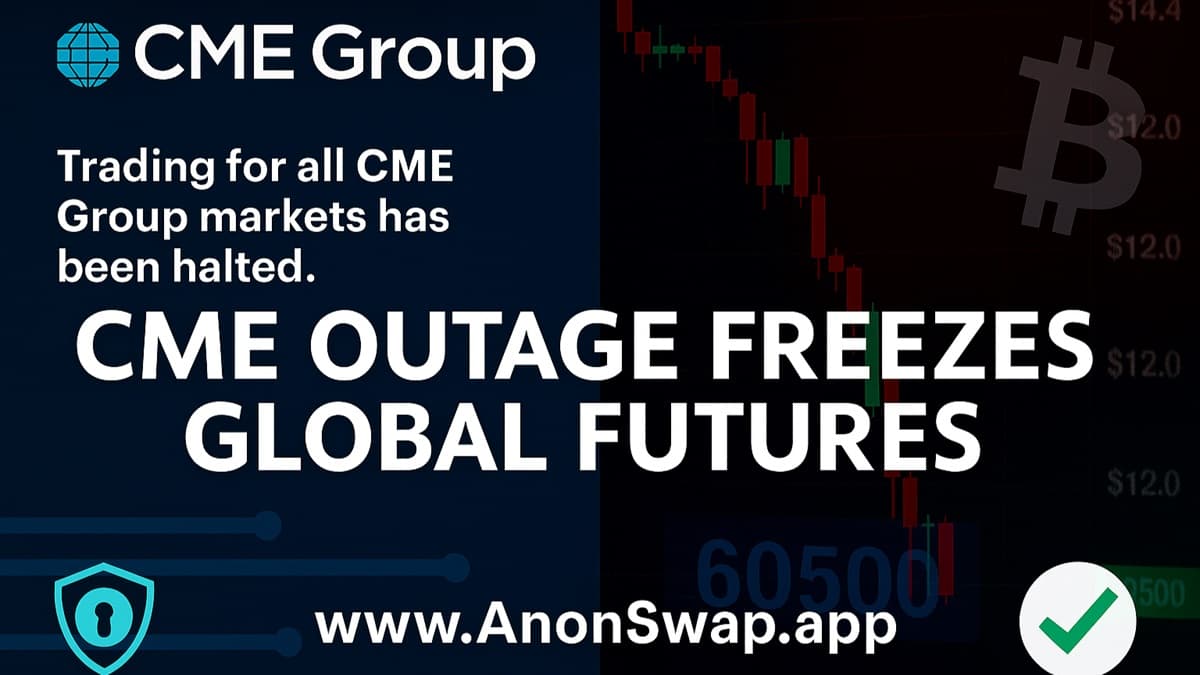
CME Outage Freezes Global Futures — What It Means for Crypto, Liquidity, and Risk
🧠 Executive Summary
- CME Group halted trading across futures, options, and FX markets on Nov 28 due to a cooling failure at CyrusOne’s CHI1 data center.
- The outage froze pricing for oil, gold, Treasuries, S&P 500, Nasdaq 100, and FX pairs, disrupting global price discovery.
- Bitcoin hovered near $92K, recovering from earlier lows, but remains volatile amid ETF outflows and liquidity stress.
- Traders should expect elevated volatility, wider spreads, and delayed hedging flows across asset classes.
- Crypto execution via private, non-custodial rails is critical when centralized venues freeze.
🏦 What Happened: CME’s Backbone Went Dark
CME’s Globex platform — the core of global derivatives trading — went offline due to a chiller plant failure at CyrusOne’s Chicago facility.
- The outage began late Thursday and extended into Friday morning.
- All futures and options trading halted, including equity-index, commodity, and rate-linked contracts.
- CME’s FX platform EBS also froze, leaving traders without live quotes for USD/EUR and USD/JPY.
This was one of the most widespread outages in CME history, affecting trillions in notional value.
📉 Market Impact: Frozen Benchmarks, Volatile Reopen
- Oil, gold, and Treasury futures stopped updating by 5:30 AM ET.
- Brokers resorted to indicative marks and internal pricing models, widening spreads.
- Options expiries and ETF rebalances collided with the outage, leaving portfolios exposed.
- Bitcoin briefly dipped, then rebounded above $92K as traders sought alternative liquidity.
The outage hit during a low-liquidity post-holiday window, amplifying its impact.
🔍 Crypto Implications: Volatility, Rotation, and Execution Risk
- ETF outflows continue to pressure BTC and ETH, with CME-linked price feeds disrupted.
- On-chain liquidity becomes more important when centralized venues freeze.
- Traders rotated into altcoins and wrapped assets with better execution depth.
- Slippage risk increases when benchmarks are stale — execution privacy matters.
AnonSwap’s private rails allow traders to swap across 1,500+ tokens without relying on centralized price feeds.
📈 What to Watch Next
- CME’s full restoration timeline and any residual latency.
- ETF flow reports — especially for BTC and ETH.
- Treasury issuance and rate futures recalibration.
- On-chain metrics: exchange inflows, stablecoin transfers, wallet clustering.
- BTC support at $90K — failure could trigger a retest of $86K.
🔐 Why Private Execution Matters
When centralized venues freeze:
- Non-custodial swaps reduce exposure to platform risk.
- Cross-chain agility lets traders pivot quickly.
- Privacy-first rails protect execution strategy during volatile reopens.
AnonSwap offers operational resilience when traditional markets falter.
Published November 28, 2025. Last updated November 28, 2025.
Frequently asked questions
What caused the CME outage?
A cooling system failure at CyrusOne’s CHI1 data center disrupted CME’s Globex platform, halting futures and options trading globally.
Which markets were affected?
Oil, gold, FX, Treasuries, equity-index futures, and CME’s EBS FX platform were all frozen for hours.
How does this impact crypto?
Price discovery disruptions in traditional markets can spill into crypto, especially during thin liquidity windows and ETF rebalancing periods.